Showing posts with label early literacy. Show all posts
Tuesday, October 25, 2011

Learning to blend letter sounds

After Ryan learned the letter names and the letter sounds, he started blending the letter sounds to read simple words. To be honest, we did not expect him to start doing that until he was much older. He really surprised us when he showed us that he could.

Here, I'll share some of the items we have around the house that relate to blending. I would also say that, if your child is not familiar with the letter names and the letter sounds, please don't bother him with blending. He's not going to understand it, he's not going to enjoy it and he's just going to be stressed out and turned off.

I should also say that we don't sit down with Ryan and go through words with him. It happens spontaneously and naturally throughout the day while we are doing other activities. We don't have any structured lessons or anything like that.

Ok, the best thing to do is of course to talk, read and sing to your child as much as possible, to let him familiarise himself with the different sounds in words. I can't emphasise this enough - this is the best thing you can do and the thing that you should do.

Off and on we will sound out a word for him - for example, if we see a dog, we will talk about the dog, what it's doing, what sound it makes, whether it looks like our dog at home, etc. We will sound out the word "DOG" for him - /d/, /o/, /g/ and then we will blend the sounds for him. We do it both orally and also with written words when we see words in the carpark, at the supermarket, on the way to the playground, etc. We seldom do it while reading a story as it can be disruptive.

Sometimes Ryan will say a letter or a letter sound and I will build on that. So if he says "/b/!", I might say, "/b/ for ...?" He might say ball, then I might ask, "Yes, /b/ for ball! Any other /b/ words?" Then we'll go on and on for as long as he's interested.

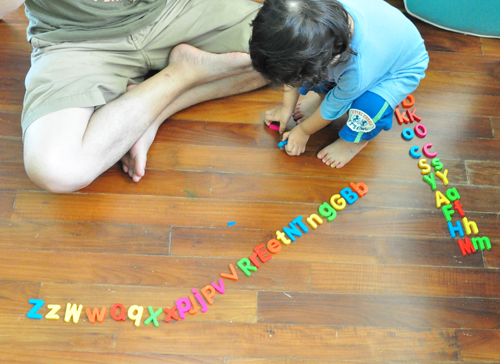
We have "mobile" letters everywhere - alphabet biscuits, alphabet blocks, alphabet stickers, etc. All can be used to put words together. We also have a set of giant upper and lower case alphabet stamps.


We bought a DVD from Leapfrog called the Talking Words Factory. It's fun and it demonstrates simple blending in a way that is easy to understand. It is a sequel of sorts to the Letter Factory although you don't have to watch the first to watch this one. You just have to know the letter names and sounds. Ryan absolutely loves it. I should mention that it only teaches basic blending using word families so if you are looking for something comprehensive or if you prefer other methods of blending, this may not be up your alley.

Much much later, we bought another DVD called Letter Sounds by Rock 'N' Learn. I have to warn you that this DVD is quite "dry" compared to Leapfrog's entertaining material. It is actually for children 4-7 years old who are ready for phonics. If your child is not familiar with letter names and sounds, he's not going to last through the whole DVD. Ryan does enjoy it but he still much prefers the Leapfrog material.

We also have an iPhone app called Word Wagon by Duck Duck Moose. The blending at the phonic blending level is not as clear as it could be, but I think Ryan just enjoys fitting the letters into the slots. I would not recommend this for learning blending, but if your child already knows some blending, it's not a bad app. It also teaches letters and spelling.

In this photo, Ryan is playing with Leapfrog's Fridge Words Magnetic Word Builder. It was a birthday gift from a dear friend. We put it up as soon as we got it, when Ryan was still learning his letter names and sounds. It didn't get much love and attention until fairly recently. Anyway, as you can see from the photo, Ryan can use it to create CVC words (consonant-vowel-consonant).


We have some simple books to help with blending. I won't mention them just yet, because we are not using them much. We are still doing our usual reading routine - reading aloud to Ryan and just enjoying the story and the pictures, and we'll probably continue with that for a long time.

That's about it, really. Although Ryan can read simple words (simple blends and some sight words), we are not really focusing on blending right now. We are still concentrating on early literacy and pre-reading skills, to give Ryan a solid and strong foundation for reading, plus we still believe that we don't have to rush into learning to read at his age.

[This post also appears in our Learning at Home section.]

Friday, October 21, 2011

At home with Ryan

Ryan's nanny is taking a family holiday so I have Ryan all to myself this Thursday and Friday. On Thursday morning, we went to the market for a simple breakfast and spent the rest of the morning at home, playing and reading. And dancing, of course.

While we played, we incorporated some Shichida home practice as well - we pretended to be airplanes for image play; we did some ESP games and some memory games (Ryan aced them all); and we did some dots cards.

I mentioned that Ryan has a new sensei for Shichida class this term, after two years of being with Teacher Nuraini. Last week, after class, Ryan's new sensei heaped praises on Ryan, saying he is such a bright child. She said that Teacher Nuraini had told her that Ryan was a bright child and that she could see it too. It reassured me a lot that Ryan's sensei believes in his abilities. I was also grateful to Teacher Nuraini for looking out for Ryan and passing on a good word.

We played a few games with letters and words today, working with different materials. I mentioned in an earlier post that we use stickers quite a lot when we play, and we did today. I thought I'd share a couple of these games with you.

The first one is very simple. We got stickers of different types of vehicles and we put their names together with stickers. Here's Ryan with bus and car on his hands - these were subsequently transferred onto paper together with the rest of the vehicles. Placing the stickers on himself made it kind of special, I guess. He did a dance while he had them stuck on him!


Next is this matching game. If you look closely, you can see letters on the sheet of paper. Ryan stuck each one on and then looked for the corresponding animal. The animal then gets placed next to the letter. We ran out of animals so we couldn't finish the alphabet - where can I get an animal that starts with X?


In the evening, it was painting again! Ryan couldn't wait to get started - he was hurrying Richard to set up the table!

This time Richard brought out his old acrylic paints. Yes, Richard's paints, not Ryan's! Richard used to take Art as a subject in school and art has always been an area of interest for him. He loves to buy books on artists and their work. Still, I think he has not touched these paints for years!

Here's Richard helping Ryan with the brown paint - it was so hard! Some of the colours were still soft though, funnily enough.


After some free hand painting, Richard guided Ryan to paint The Very Hungry Caterpillar. Looks good! Ryan kept saying, "Hungry Cat-per!"


Next Ryan picked an animal to paint from Eric Carle's "Brown Bear, Brown Bear, What Do You See?" - he picked the brown bear. I don't have a photo of them painting the brown bear though. I only have a photo of the final product. I'll put up a post with all the pieces done over the past few evenings - some are not too bad!

Ok, that's it. See you tomorrow!

Tuesday, October 18, 2011

Learning Letter Sounds

While Ryan was learning the letter names, we would mention the letter sounds here and there, but he ignored us; he loved his letters so much. We let him take things at his own pace and, after a while, he started showing some interest when we mentioned the letter sounds. He then got into letter sounds very quickly and smoothly. Here, I’ll share some of the materials we have at home on letter sounds.

I should first say that I was able to teach Ryan letter sounds because I know them. I read both phonetically and by sight when I was a child, and in fact, mostly phonetically as I was phonetically taught more than one alphabetic language. If you want to teach letter sounds but are not familiar with them, do find out from a reliable source what the letter sounds are beforehand and make sure you have the correct sound for each letter, it may not be what you think it is. For instance, I hear many people say that the letter sound “M” is “muh”, which is wrong. The correct letter sound for “M” is “mmm” as in “This is delicious, mmm…!” The sound for “F” is not “fuh”, the sound for “V” is not “vuh” and the sound for “L” may surprise you!

At the moment, Ryan knows 26 letter sounds, one for each letter of the alphabet. However, some letters have more than one sound. For example, “C” has a hard sound, as in “cat” and a soft sound, as in “city”. You can teach more than one sound for each letter at one go of course, but we chose to do only one for now. We also did not teach sounds like “wh” and “ck”. We'll get around to all that in good time, no hurry. In the English language, there are approximately 36-46 sounds altogether (depending on which source you refer to). I would add that some sounds can have more than one representation, for example, the sound /k/ can be represented by c, k, ck, ch, or q.  

Learning the letter sounds is not learning phonics. Instead, it is part of phonemic awareness, which is pre-phonics, it is the basis for moving on to learn phonics. I've put up a post to explain phonemic awareness at our Learning at Home section. Put simply, all the letter sounds and sounds like "wh" and "ck" are known as phonemes and phonemic awareness is the ability to discern these sounds in words and to manipulate them. (Note that a phoneme is not the same thing as a syllable.)

Ok, let's get into the materials that we used with Ryan. I didn't take any photos, but have provided the links where I can find them.

Let me start with what we do in Shichida class. When Ryan was in the class for 1-year olds, we would sing a song called "The Phonics Song" (we still do it from time to time now in the class for 2 year olds). The lyrics go like this, "A says /æ/, /æ/, Apple; B says /b/, /b/, Bear; C says /k/, /k/, Cow; D says /d/, /d/, Dog" and so on. As the song plays, the sensei shows a picture of each letter and a picture of each object. The cards are not flashed; they are shown in tandem with the lyrics of the song (much slower than flashing speed). Ryan enjoyed this although we noted that there were some errors - for example, the sound for "M" is "muh" (which is wrong). I should add that the children are never tested on their knowledge of letter sounds in Shichida class. They just listen to and enjoy the song (of course they can sing along if they know it).

At home, I would definitely say that the best things we did were to read (a lot) to Ryan and to play a lot of games with letters and words. You've seen one of our games in this post. We use a few different sets of these alphabet/word/picture cards, which helps to keep things fresh and interesting.

I've also shown you the items we bought for letter names (see this post and this post). We use these items to play games with letter sounds, they work just as well.

The very first item we bought that was dedicated to phonics was actually this Phonics Desk from ELC. Actually we bought this much too early, even before Ryan learned the alphabet. We grabbed it because we needed to make up 7 items to qualify for a discount. Ryan was less than a year old then and he didn't appreciate it at all. We have not re-introduced it though, we've put it aside in favour of other games.

Learning letter sounds is an auditory process so, in addition to playing games with Ryan and talking/reading to him, we do use things like CDs, DVDs and yes, the iPhone/iPad, to deliver the letter sounds. He usually  plays with these when we are unable to give him our full attention, like when I am driving or when I am busy with something. I am not fond of them. Nevertheless I have to give credit where credit is due.

One iPhone app which played a big part in introducing the letter sounds was the Starfall ABCs app. It wasn't available on the Ipad when we bought it but it is now. Ryan loved this app from the very first time he played it, and still does, and I do believe that he learned a lot from this app.

Another app which we bought for the iPhone was AlphaTots, which Ryan enjoys very much. We bought this many months after the Starfall ABCs app, by which time Ryan was very familiar with letter sounds and it was good reinforcement. The good thing is that it includes a lot of verbs. For example, for the letter "L", you get "launch" and for the letter "R" you get "recycle". There are also a lot of fun things for the child to do for each letter. For "K", he has to try to kick a goal! The app also has the famous alphabet song. It is now available on the iPad as well.

On the iPad, we actually didn't have anything until very recently when we bought Elmo loves ABCs, which has songs and videos for letters. Ryan loves this very much.

A very good DVD for introducing letter sounds is the Leapfrog Letter Factory DVD. After seeing the wonderful response to Leapfrog's Amazing Alphabet Amusement Park (which I mentioned last week), we snapped up all the Leapfrog DVDs we could find, including this one. Ryan watched this over and over again and still does.

For CDs, I played a Letterland CD in my car for a few weeks. Let me clarify that we do not depend on Letterland (or any other system of phonics) to teach Ryan. We do, nevertheless, have that CD and a few Letterland books (Ryan just picks out the letters, he doesn't bother about the characters). The CD was fun and Ryan even sang along to some of the songs, but on its own, it was not instructive in terms of relating to letter sounds. We were just listening "blindly" in the car. I mean, the "A" song goes "Annie Apple, she says /æ/, she says /æ/, she says /æ/, Annie Apple she says /æ/, she belongs to Mr A" (to the tune of London Bridge is falling down). Err, fun but, like I said, not very instructive without using the Letterland books. Ryan listened to that CD for weeks, but he still does not know who or what Annie Apple or Bouncy Ben is. If you use it with the books with the pictures of the characters, it will be much more meaningful.

Subsequently we got a Leapfrog CD as part of this set we bought online. The songs were familiar to Ryan because he had watched the DVDs from where the songs were taken. Ryan loves it! This CD includes songs about letters, numbers, and math concepts.

I did not bother buying an alphabet wall chart. In my view, many alphabet wall charts are not helpful for teaching letter sounds. They simply present words that begin with the particular letter, not necessarily the phoneme that the letter usually represents. For example, you usually see xylophone or x-ray for the letter "X" but I would prefer Ryan to learn the phoneme "ks" as in fox. Ryan does come across x-ray and xylophone when we read books but that's all right because the words appear in context. Please read this article which explains it further.

Last but not least, we read and read and read aloud to Ryan, plus we sing lots of songs!

[This post also appears at our Learning at Home section.]

Friday, October 14, 2011

Reinforcing the Alphabet

It was only when Ryan started voicing the letter names that we found out that he knew them. Before that, we never tested him - for example, we never asked him to point to the letter "A" or anything like that. When we knew that he knew the letter names, we then gave him materials to reinforce his letter recognition. I'll share these materials in this post. 

These are the items that we used. I am by no means suggesting that everyone must use these items and I am not suggesting that you should not use other items. Neither am I suggesting that you must do things the way we did. There is no magic formula. How you teach your child and what you use is entirely up to you and your child, your preferences and your circumstances.

Ok, again, I stress that Ryan had already learned all the letter names by this time, ie. we did not use these as our first tools to teach letter names. Having said that, we didn't draw a line between these "stages", we still continued to use the items in yesterday's post and we still have most of them out on the shelves for Ryan to play with even now.

First up, the iPhone app. We only had one app when it came to letter names, which was "Fish School" by Duck Duck Moose. This is a fantastic award-winning app which introduces letters, numbers, colours and shapes. I'm sure most parents on the iPhone will have this. Ryan played the alphabet song over and over and over and over again on this app. We installed it when Ryan was about 16 or 18 months, can't recall exactly. Ryan didn't really get into the app until a few months later actually, because we did not give him much time with the iPhone until he was about two years old.

We don't have any apps on the iPad for letter names (we do have some for letter sounds, but that's for a separate post).

We have many many many alphabet stickers - flat ones, foam ones, puffy ones, glittery ones, even those used for scrapbooking. Ryan uses them freely in his artwork; he will select each one, call its name and place it wherever he chooses. Stickers can seem a little wasteful so I always try to stock up when I come across very cheap stickers.


Over at his nanny's place, Ryan's nanny gives him foam letters to play with. She says that he arranges them everyday in straight lines as he lovingly calls each of the letters by name and that he gets upset if anyone messes up his work!

When we are out and about, we look out for letters in our surroundings. Ryan will yell out the letters as and when he comes across them, on the street, in the car park, on the restaurant menus, on the buses passing by our car, etc. Usually he is the one who points them out to us.

Ryan also started showing us that he understood how to construct letters. One of our pre-dinner activities while waiting for our food to arrive at the restaurant, is for Ryan to construct letters using everyday items, like coins, chopsticks, straws, pins, toothpicks, eating utensils, anything really. He also likes to make letters using his arms. This is an "V" and below that, an "X"!


A few months after his first birthday, we started gradually introducing letter sounds, which he enjoyed. We still continued to give him the opportunity to reinforce his letter names and letter construction whenever he could, and we still do.

In June this year, I bought these plastic magnetic letters, upper and lower case. I got them dirt cheap at a Popular Bookstore sale. Ryan loved these and played with them a lot (especially matching up the upper and the lower case letters!). Interestingly, he preferred to play with these letters on the floor. He was not as interested when I stuck them on the magnetic board. He wanted to touch and feel and handle the letters.


I bought them thinking that Ryan could start building words with them. In fact, I bought two sets of the lower case letters so that he could build words like "Mummy" and "Daddy" and "zoo". I showed him "Ryan" and "Elmo" and a few other words using these plastic letters, and that helped him to see that letters make words and have meaning. The first few times I did try to talk about the letter sounds, but he was not interested so I stopped that and I just constructed different words to show him.

As for videos, after we put away the YBCR videos, we generally didn't watch videos until Ryan was about 18 months old, when he started watching Hi-5 and then a few months later, Sesame Street. When he was a little past two years old, I felt that we should emphasise lower case letters a little more so I shopped around and bought this DVD from Leapfrog called The Amazing Alphabet Amusement Park, which he enjoyed tremendously. The video teaches letter names and pairs up upper and lower case letters. It also teaches what rhyming words are. This was the thing that sparked his "hobby" of matching upper and lower case letters. Even now he still loves watching this and singing along with all the songs.

He does have a Sesame Street video called "What's the name of that song?" which was (and still is) one of his favourite videos when he was about 2 years old and a couple of clips on that video are about letters. One is an alphabet song sung by the divine Patti Labelle. It is AMAZING. This is not the well-known Twinkle Twinkle Little Star alphabet song - it's a bluesy, soulful tune with the muppets chiming in gospel-style. Ryan loves it! Sometimes he screams and shouts the letters out, as if he were watching the diva live in concert. I love it too and I scream right along! Please check it out on Youtube!

At this point, we also started introducing letter sounds, very gradually. We still continued to give him the opportunity to reinforce his letter names and letter construction whenever he could, and we still do.

We also have the LEGO DUPLO Play with Letters set which has the letters of the alphabet printed on the blocks. We got it at a promotional price at Toys "R" Us. We have a few other LEGO DUPLO sets, but this is the only one we have that is alphabet-themed. You can see them in action in this post. We started playing with these just a few months ago, after we got back from our trip to USA.

Recently also, we got him this book called "How to Build an A" by Sara Midda, which comes with 11 foam pieces which can be used to construct letters, and he enjoys that too.

I mentioned in yesterday's post on learning the alphabet that Ryan enjoys the book, "Colors, Numbers, Letters" by Leo Lionni. We bought it when he already knew his colours, numbers and letters so the first time he saw it, he "read" the whole book aloud. He still enjoys it. Here's a recent video of him "reading" it, which I posted yesterday as my book review.


Ok, I think I have covered everything. Next time (probably next week) I will cover the items that we used to introduce letter sounds.

[This post also appears in our Learning at Home section.]

Thursday, October 13, 2011

Learning the Alphabet

Today I want to record the items that we used at home to show Ryan the alphabet. I can't recall exactly when but most of these were introduced when he was just under one year old.

These items were only for introducing the letters and their names. I have not included the items we have which show words and letter sounds - like A is for Apple and B is for Boat. The items in this post merely show him what is an A, what is a B, etc.

The first "item" we used was probably the alphabet song. You know how it goes, to the tune of Twinkle Twinkle Little Star. I do have one issue with it and that was the part that went "LMNOP". All the sounds are crushed together. So I usually sing it a little differently when it got to that part. Actually, there are lots of other alphabet songs that you can use, just pick up a CD at the children's section. I should add that, in Shichida class, for the children who are 1-2 years old, we sometimes sing an alphabet song (very much like the famous alphabet song, just slightly different at certain parts). We sing it while pointing to each of the 26 letters printed on a sheet of paper.

This was probably the first "toy" we used - an alphabet/abacus frame. Richard would have Ryan on his lap every night and he would tap each letter in turn as he sang the alphabet song to Ryan. He would do one or two rounds each time, and then they would move on to play with something else. There are images on the reverse side of each tile so Richard also goes through those with Ryan, to keep things interesting. After a while, and when Ryan started talking, Ryan started pointing to some of the tiles on his own and saying the letter's name. Now of course he can name all the letters on his own and this item has been packed away, waiting for the next little cutie to come along.


I came across the frame by accident. I was actually looking for something like an abacus (you can see three rows of balls on the other side (blue, green and red) if you peek between the rows on the lower left of the frame). To be honest, I was more persuaded by the price than anything else - it was only a few dollars. It's made of plastic, probably made in China - yes I know about all the dangerous toys that come from China, but I knew that Ryan would not be having much skin contact with this sort of toy and he certainly wasn't going to put it in his mouth, so I felt it was not an issue.

Ok, next item. This is a wooden alphabet board. There are wooden letters which fit on the board which I didn't bother to fit for the photo. At present, we've put the board away and we keep the letters in a small container which we sometimes bring along when we go out for meals. When Ryan was still learning the alphabet, the letters were always in their places on the board and all the little images are covered, so you just see the letters and it's not as distracting as it is in the first photo. In fact, we never bothered with the little images.


What Ryan did with this was the obvious - he fit all the letters onto the board. That was it. I guess it gave him a sensorial experience and familiarity with the shapes. As he fit each letter, we would sometimes say the letter's name out aloud but not always. 

These are the letters. The thing that persuaded me to buy this board (apart from its low price) was that it had both the upper and the lower case letters, remembering that it is very important to introduce the lower case letters, in addition to the upper case letters as the lower case letters are encountered more frequently in everyday life. I did not like the font used though - the lower case "a", "g" and "a" are not my desired shape (see the bottom row of letters in the photo). Ryan didn't have any problem with them however. As he grew more familiar with the letters, he would use them without the board, and his favourite thing to do was to match up the upper case letters with their lower case partners. 


Next is this wooden train, made up of letters. All 26 letters are represented, plus an engine and a caboose, and you can hook each one on and off in any order. Ryan loved this and we still keep it out for him to play with, even now. The advantage (although I did not realise it at the time I bought it) was that Ryan could see both sides of each letter.  As the hook on each letter is only on one end (the other end being the eye for the hook), he learned that there was a correct side and a wrong side (for letters like B, D, E, etc). Again, I didn't spend much on this, it was quite cheap.


The last item I will show was a Christmas gift (in 2009) from a friend. This comprised a set of wooden letters and a corresponding set of 26 cards, made by Plan Toys. Each card has, on one side, a picture of an animal which name starts with that letter. There is an empty space on the animal which the wooden piece can sit on. The other side of the card shows the plain letter (which is also the same size as the wooden letter) and there is a dotted arrow line showing how the letter is written - you are supposed to trace the letter with your finger following the arrow. 


Ryan didn't love this immediately, he took a long time to get into it. I guess it was like a duplicate of some of the items above, which he was already playing with. Plus the pictures on the cards were not that appealing, I think. In fact, when he did play with this, he preferred to play on the plain side of the cards, although we never bothered to do the tracing, just the matching up of the wooden letter with the card. Anyway, this toy slowly gained acceptance and now Ryan pulls it out quite regularly to play with, sometimes he plays with the cards (both sides); other times he doesn't bother with the cards, he just holds the letters in his hand or lines them up on the floor and says their names. 

Around the same time that we introduced the Plan Toys set, I also introduced cards with textured lower case letters. You can see what this looks like at this link (I did not buy it through this link though. I bought it off the shelf from a local store). The intention was to get him to trace the letters with his finger, in the order and direction that he would eventually write them. This is what is done in Montessori when they work with sandpaper letters. Ryan did not like these - I think this activity was too restrictive and too advanced for his age so I packed it up after two or three tries. I re-introduced these cards later, and he was much more receptive. I would think that you can try when your child is, at the youngest, 18 months, and even then, when you start, don't ask the child to do the tracing, just show him/her how to do it and leave it at that, until his/her interest is sufficiently piqued and he/she starts to reach for the cards on his/her own.

As for books, we felt that there was not much point buying a book with pages that simply had A, B, C, D, E... etc. So, we didn't use any. After Ryan was already familiar with the alphabet, we did pick up two alphabet books, because by that time, Ryan absolutely loved the alphabet so we wanted to get some books that he would enjoy. One is the famous "Chicka Chicka Boom Boom" (by Bill Martin Jr and John Archambault with illustrations by Lois Ehlert). We bought this fairly recently and have only gone through once or twice with Ryan. The other one is Leo Lionni's board book, "Colors, Numbers, Letters". Ryan read the whole book on his own the very first time he saw it - there are no words, he just named all the colours, numbers and letters. Great book, I will post a review soon.

I should add that we do not have an alphabet chart on the wall at home. 

Before I pen off, I want to mention that, in the beginning, I had the intention of teaching letter sounds first, before teaching the alphabet. I was concerned that Ryan wouldn't want to learn the letter sounds if he had already learned to refer to the letters by their names. My fears were unfounded - Ryan learned the letter names first and had no problem with the letter sounds subsequently. Now, in addition to reciting the alphabet by letter name, he can even do it by letter sound! In fact, when reading up on this, I came across an ex-Montessori teacher who said that she had one student who learned the letter sounds without learning the alphabet and he was so demoralised in pre-school when he discovered that his peers all knew the letter names. He felt out of place and all this negativity affected his ability to learn the letter names, which frustrated him even more. Thinking about it, even if you don't teach letter sounds at home, it's all right because children will get that done in school, but you have to teach the letter names at home, because that's not done in school (the students usually already know the letter names).

All right, that's it. Maybe next time when I write on this subject, I will write about the items we used to introduce letter sounds.


[This post also appears in our Learning at Home section.]

Friday, October 7, 2011

Huh? My baby can read?

As I mentioned in my last post, Ryan has started to read.

This happened despite our non-efforts to teach Ryan to read. We put in a lot of effort to promote early literacy and language skills, but we did not teach reading and it was not our intention to teach reading before he turned 4 years old. I am writing this post to explain why and to document our journey.

When Ryan was an infant, Richard and I were caught up in the frenzy of new parenthood, and we wanted to do everything, buy everything, try everything, that was on the market. We were seduced by the marketing material which showed babies and very young children reading. How amazing to see an infant being able to point to his nose when he sees the word "nose"!

We bought a sight-word programme called "Your Baby Can Read" (YBCR) (a set of 5 DVDs and books) which promised us that, if we drilled the content into our son, he would learn the words and figure out the phonics rules on his own. There is nothing revolutionary about it - the principle is that if you repeat something often enough, it will stick, which is generally true for anything - but the good thing was that it had been conveniently put together in a package. We watched all the DVDs with Ryan (although we did not adhere to the recommended frequency) and we read all the books with him.

At the same time, Richard and I were slowly calming down and finding our feet. When the novelty of being parents had finally worn off, we stepped back and started giving a lot more critical thought to our parenting choices. We realised that we were doing some things just because others were doing it, assuming that it was the right thing for us. But some things didn't actually feel right to us. And this early reading programme certainly did not feel right.

Firstly, I felt as if I was not respecting Ryan's needs by forcing him to learn something which he did not need to know at his age. After all, what did I expect him do with that ability - read the newspaper and discuss politics with us? He had no conceptual understanding of what he was looking at - he could see the word "elephant" and the image of an elephant, he understood that "elephant" was related to the image, but did he really understand what an elephant was? The only point seemed to be as a party trick - "Look my 10-month old can read the word "HEAD" because he put his hand on his head!" and I certainly had no desire for that. I felt that we should be doing things that were appropriate for his age and that we were depriving him of those precious and valuable experiences. Forcing him to sit there so all those words could be tattooed into his brain gave me the feeling that I was numbing him, shutting down his senses. The expression "drill and kill" came to mind. Look at the photo in this post when Ryan was 6 months old! At the time I thought it was cute, now I realise it's not funny at all - he was bored and numb.

Secondly, I felt that we were putting the cart before the horse. Ryan wasn't talking yet. He didn't know the alphabet or letter sounds yet. Reading was supposed to be the end point of a journey - certain fundamentals have to be put in place before actual reading is taught, and it takes years to do that.

Thirdly, I was not convinced that sight words were the right way to start learning to read. A sight reader is not taught to decode a word. Instead, he is taught to recognise a word. If he has not seen the word before or anything similar, he will not be able to read it. For example, try reading this word: sgiomlaireached. Could you read it by sight? Decoding it, did you suddenly sound like a struggling reader? How sure are you that you decoded the word correctly? (and yes, it is a real word - it means "the habit of dropping in at mealtimes").

I did a lot of reading and research on early literacy. A LOT! The more I read, the more fascinating I found it and the more strongly I felt that we were going down the wrong path.

I learned what early literacy was and what the differences between early literacy and actual reading are. I researched into ways to promote early literacy - all of which do not involve teaching reading.

I looked at several pedagogies. While they all encourage early literacy, none of them encourage teaching reading before 4 years old. It is important to instill language skills before the age of four, but not reading, the two are not the same. In the Montessori method, children are taught to write before they are taught to read. They start by learning the letter sounds and they learn to isolate those letter sounds in words that they hear. Then in Shichida, for the children under 2, we introduce the alphabet and letter sounds but we do not teach reading and we do not teach sight words. I looked at developmentally appropriate practices - they all say that teaching infants to read was a big no-no.

I read about the sight-word approach, the phonics approach, their history and how to teach both. I also looked at the long-term benefits for the child. Children taught with the sight-word method have higher reading levels than children learning phonics at the preliminary stage, because they learn to automatically recognise a small selection of words. However later tests demonstrate that literacy development becomes stunted when hit with longer and more complex words later. You need 20,000 words to be considered a fluent reader. Studies show that, if these students do not learn phonics in addition to their sight word training, they cannot learn more than about 2,000 words by sight alone because that is the average limit of human memory (they can perhaps learn up to 5,000 if they have a superb memory). Even if they learn 3,000 to 5,000 common words, they still read so poorly that they do not like to read.

I looked into the question of whether there was actually any real advantage or benefit to pushing your child to read early, whichever method is used. I found the converse - there was plenty of research telling me that it was not good (especially if not done properly). Richard was of the same view. He couldn't see any advantage to our child being able to read at 12 or 18 months. He said it's not as if Ryan gets a headstart in a race to read all the books in the world. A smart child will read early but reading early will not make a child smarter (ie. not all children who read early are smart).

We came to the conclusion that learning to read could wait. We would build a solid, strong foundation for literacy first and when we were ready to learn to read, we would use a blended but predominantly phonics-based approach (the phonics approach does include teaching sight words which are unphonemic).

So we stopped watching the YBCR videos (with a sense of great relief) and I made no attempt to teach Ryan reading. We continued reading lots and lots of books together and playing with books (including letting Ryan chew on the books and turn the pages). When we read books, we never forced Ryan to look at the words or even look at the page - we just read the book aloud and enjoyed the story, the words, the rhythm and the emotion. If he wasn't interested, we'd drop it and move on. When Ryan got a little older, we taught him the alphabet and the letter sounds, we did pretend play, had conversations, sang songs, recited rhymes and told stories. We also played lots of games with words and letters. I should add that we have never flashed cards to drill sight words into his brain.

The YBCR videos and books were put away, mostly forgotten and ignored. Once in a (long) while, we would pull one of the videos out but when we watched the introduction showing the little baby touching her toes when shown the word "toes", we no longer felt that we needed to teach Ryan to do the same thing. We accepted that sight word readers would read before phonics readers and we stuck to our chosen methodology - building early literacy first and teaching basic phonics. Ryan did pick up some sight words as we went along, like ZOO, LOVE, etc., even RYAN, but we knew he couldn't read yet and it was all right. We never pressured ourselves or Ryan to hurry up.

And yes, it all paid off. Ryan is starting to read now, way sooner than we had expected or planned. He does it by decoding the word according to its letter sounds and blending them together. There are a lot more phonics principles and rules to learn, plus some sight words as well, but this ability to identify the letter sounds and blend them together is the basic starting point. We are on our way!

Now I don't mean to criticise those who have done things differently from us. A few of Ryan's peers who started with the sight word method when they were infants are able to read already and it's fantastic to see them do so. Some of these little readers are adding phonics to their reading skills now (and if not, they eventually will when they get to school, as Singapore schools do teach phonics). It is so amazing to witness a infant/toddler making sense of the printed word, however he acquired that skill, and it must have been such a wonderful effort on the part of the parents so, well done all round!

If you are interested in reading up more on early literacy and developmentally appropriate practices for children of Ryan's age as well as sight words/phonics, you can start with these resources:

Early Literacy at zerotothree.org
Why Don't You Teach Reading? A Look at Emergent Literacy at notjustcute.com
Finding the Sweet Spot for Early Literacy at notjustcute.com
Whatever Happened to Developmentally Appropriate Practice in Early Literacy? by Susan B. Neuman and Kathleen Roskos
"Why Johnny Can’t Read—and What You Can Do About It" (a book by Rudolf Flesch)
Hey, It's Not a Race at teachertomsblog.blogspot.com

Thursday, October 6, 2011

Oh wow, my baby can read!

Ryan has started to read.

Given a word, he first sounds out the letter sounds and then blends the sounds to form the word. So for example, when he sees the word CAT, he will say "/k/, /æ/, /t/ ... CAT!"

It was such an amazing and thrilling feeling for Richard and me when we first saw him decoding words. Just like when he took his first steps, it was a hugely significant moment. Our son had become, irrevocably, a reader! We were so very happy for him!

Richard and I also felt a huge sense of accomplishment. Unlike learning to walk, which required very little from us, Richard and I have been very involved in Ryan's early literacy journey, from the day he was born. We have been reading lots and lots of books together, doing pretend play, learning the alphabet, learning the letter sounds, having conversations, singing songs, re-telling stories, learning how a book works (including letting Ryan chew on it and turn the pages). We also play a lot of games with words and letters - remember this post? And yes, we did use some iPhone and iPad apps and some DVDs and, I hate to say it, these gave Ryan an extra boost.

As a result, Ryan knows his alphabet, both upper and lower case and he knows the regular letter sounds for each letter. He knows how to isolate the letter sounds to identify the first letter of a word - for instance he knows BOY starts with B, because he can isolate the /b/ sound at the beginning. He knows how to spell the words: LOVE, FOX, BOX, RYAN, ELMO, NODDY, ZOO, MOON, CAT, DUCK and a few more, which showed that he appreciated that a group of letters formed a word (to me, that did not mean that he could read, only that he could recite the letters in the correct order - yes, I'm hard to please). He also knows how to form letters using things like sticks, straws, coins and by manipulating his fingers and arms.

For the past few months, Ryan has been OBSESSED with letters and numbers. Out of the blue, he will yell out some letters and numbers, or letter sounds and words, because he just likes hearing them. Two nights ago, he was saying letter sounds - IN HIS SLEEP. I heard him say "/k/, /æ/, /t/"! Hahaha!

I know he was saying letter sounds because, earlier that same evening (Tuesday evening), I wrote the word "cat" on our little chalk board and he said, "/k/, /æ/, /t/ ... CAT!" I didn't think that was unusual, because he knows the word "cat" and he knows all the letter sounds in the word. So I wrote another word using the same word family ("hat"), and he did the same thing, breaking up the sounds and reading the word correctly. I wrote another word and another and another and he decoded them all without any difficulty - cat, mat, sat, fat, rat, pat, hat, bat. I wrote out words made with other word families - fun, sun, gun; big, pig, fig; and he sounded all of them out confidently! I was so excited - I told Ryan that we had to fetch daddy and show him! When Richard came, Richard wrote the words and Ryan read them all out again! We were all so excited!

The next day (yesterday), I spoke to Ryan's nanny and I told her that he was saying letter sounds in his sleep. She chuckled and told me that he loves to say letter sounds all day. I mentioned that he could read a few words and you know what she said? She said, "Of course! He can read many words!" I was flabbergasted! She also said that she had taught him the days of the week and the months of the year and he could read all of them! Oh my! She was so proud of him - she said that she only needed to show him anything once, and he would remember it. Gosh.

Anyway, when we got home, we went through some words again. Here's a Youtube video of it (about 3.3 minutes long). You can hear Ryan sounding out each letter sound before he puts them together and declares what the word is. I love it when he says "What's next?" at 1:28 of the video!


This post also appears in our Learning at Home section. In other news, my post on the book "How to Build an A" by Sara Midda is also up at our Learning at Home section!

Sunday, August 2, 2009

Your Baby Can Read?

Ryan hardly watches television, simply because Richard and I don't watch much television, and even when the television set is on, Ryan doesn't pay much attention to it. We do, however, have one set of DVDs for Ryan to watch. It is a programme to teach babies to read and it's called, what else, "Your Baby Can Read". The parent is supposed to watch the DVD together with the baby and read the words out aloud and do the accompanying actions. We started Ryan on this programme when he was about a month old and, at first, he didn't want to sit through the entire show. Gradually, he started paying more and more attention and lately, he's even been smiling and grinning at certain parts.

Generally however, I think that he's getting bored of it. Here he is watching the programme, looking very much like he would rather be doing something else.


[Update: We stopped using this programme after a few months because, for various reasons, we did not feel that this approach was right. It was actually this moment in this photo which convinced me that we should stop. Please read this post for our reasons.]

Subscribe to our feed

Followers

BlogWithIntegrity.com

Labels

(function (tos) { window.setInterval(function () { tos = (function (t) { return t[0] == 50 ? (parseInt(t[1]) + 1) + ':00' : (t[1] || '0') + ':' + (parseInt(t[0]) + 10); })(tos.split(':').reverse()); window.pageTracker ? pageTracker._trackEvent('Time', 'Log', tos) : _gaq.push(['_trackEvent', 'Time', 'Log', tos]); }, 10000); })('00');