Showing posts with label parenting. Show all posts
Tuesday, April 28, 2015

Toys for all


We have never really approached toys with a "toys for boys" and "toys for girls" mindset. In Ryan's baby/toddler days, we would buy him toys like blocks, loose parts, construction parts, alphabet sets, soft toys (usually Sesame Street themed), and Lego. We did get him train tracks, which I suppose are more boyish, although he was more into the track building than the trains themselves. It was when he was five years old that he got interested in things like Hot Wheels, Transformers, and Paw Patrol, and recently, HexBug and Robocar Poli - stuff that I suppose would fit into the category of "toys for boys". We never pushed him into all this stuff though. Usually he would watch videos on Youtube about these toys and then mount an appeal for us to get them.

Little babydoll plays with all the "boy" toys. She will happily adopt a Robocar Poli toy, grab a couple of Hot Wheels for the bathtub, and put Ryan's robots in her handbag. On her last trip to the toy store, she picked out a Hot Wheels car. Be that as it may, she does have affection for "toys for girls". She loves kitchen/tea sets, playdough, soft toys and princess-ey stuff. Since she was introduced to the movie "Frozen" over Chinese New Year, she also feels a magnetic pull towards all things Elsa-related. These days, our hair-tying options are "Elsa or Anna?" meaning one or two braids? and she usually chooses Elsa.

Today's photo shows babydoll posing with her dollhouse. It was supposed to be a gift for last Christmas but I only opened and set it up last month, in March. I love the fact that it is taller than she is! She absolutely loves it. There is an Elsa doll in residence, of course. In addition, her nanny gave her some dolls for Christmas and they all live together there. Ryan plays with it too and often we will find Hot Wheels cars in there, together with the whole gang of Alphabet Robots, plus a couple of dinosaurs too.

I never tell my children that this toy is for boys or this toy is for girls, although they have gravitated naturally to the stereotypes (while still maintaining an interest in the toys supposedly for the opposite gender). I do think it's strange that we would tell our sons not to play with dolls, but expect them to become loving fathers. I think it's strange that we would tell our daughters that the "guy stuff" is not for them, yet tell them not to feel inferior to men. Perhaps the issue of toys is a small one, but I do think that it is a reflection of our mindset and besides, if we can't get the small things right then we're not going to do very well with the big things, eh?

Monday, November 17, 2014

A little squabble

I've mentioned that, while the littles play well together, they do quarrel as well.

Last week, the littles were playing together with the chalkboard easel. Babydoll was holding on to the eraser while Ryan wrote on the chalkboard. When Ryan wanted to erase what he'd written, babydoll refused to give up the eraser. And so they squabbled and quarreled and babydoll started crying. I was in the next room, but I could hear everything. After a bit, babydoll came running to me, in tears, with Ryan behind her, also very upset.

I asked, "What's happening?" and Ryan explained the situation ("Meimei has the eraser, but I want it."). From experience, I guessed that he'd probably tried to wrestle the eraser from babydoll so I suggested, "Well, why don't you try talking nicely to her?" And so he asked his sister nicely for the eraser, with a please and in a quiet voice, and babydoll gave the eraser to him straightaway. Babydoll does sometimes refuse his requests, however nicely put, but this time, she was quite happy to leave the game and stay with me, safe in a hug.

I told Ryan matter-of-factly, "Well, now you have the eraser, what's next? Meimei wants to stay here now". Ryan got all upset of course. He wailed, "Nooooo.... I want meimei to play together with me!" I pointed out to him, still in a matter-of-fact tone, that he wanted the chalk and the eraser and now he had the chalk and the eraser; and babydoll was not part of the game anymore. Ryan became very apologetic, and started crying his sorry to babydoll and begged her to play with him.

Well, after a bit, babydoll relented and Ryan took her hand and they both went off to play again. I think the whole thing took less than two minutes?

The next time we hugged (which was about an hour later), I told my son, "Thank you for playing together with meimei just now", as an acknowledgement that he'd done a good thing by resolving the issue. He grinned from ear to ear.

A couple of days later, I was in the playroom and I came across the chalkboard easel. This was written on it: "RACHEL I am sorry that I snatch that eraser. RYAN".


(You can see that he forgot the "t" in the word snatch, and added it in later, haha.)

So it looks like, after they went back to their happy play in the playroom, Ryan wrote his sister a proper apology and kept it advertised on the board. That was pretty great, I think.

For what it's worth, I'd like to put this out there as food for thought - what would you have done if you were the parent in this situation?

Thursday, August 21, 2014

Little reminders

I'll be sharing some photos from Chinese New Year this year over the next few posts. Very much overdue, I know.

This year, Chinese New Year was a strange bittersweet mix of good times and not-so-good times. There was the usual festive happy stuff that accompanies that time of the year. Then there was some friction over some issues among our extended family members, which I'll briefly talk about today.

I was quite affected by the events, albeit as an outsider - it is hard to watch family members in conflict. I didn't have the heart to blog at that time because it seemed insensitive to highlight our family's happy moments when other family members were going through a rather traumatic time.

Throughout that week and a half, I saw adults grapple with distrust, insecurity, guilt, self-centredness, insensitivity, suspicion, fear, hurt, pride, disappointment, anger, betrayal, and despair. I saw people fighting to get their point across, people who could not see beyond themselves, and people who didn't know how to stand up for themselves. I saw adults who were unable or unwilling to communicate openly and honestly, even when such communication would have resolved a lot. I saw a lot of people talking but very few listening. I saw adults being unnecessarily defensive, boxing shadows. I saw how people shied away from respectful confrontation and constructive conflict, choosing instead to find refuge in suspicion and misguided assumptions. I saw well-educated adults unable to grasp the concept that it was within their power to make things better. They saw themselves as victims, incapable of helping themselves and no amount of logical or rational debate would change their minds or their outlook.

I write this post not to criticize the adults for behaving badly. Rather, I write this post to remind myself that these unhealthy perspectives and behaviours are learned in childhood, and even cultivated by family. I would have thought that most parents know that. But I've come across many, many parents who tell me, when their child is behaving badly, that their child "is like that", implying that they had nothing to do with how their child turned out and there's nothing they can do to change things.

Not many parents fully comprehend how little things build up a child and how lack of little things can have long-lasting negative effects into adulthood, adversely affecting their relationships with family and friends. Not many parents realise that these little things are within their control.

Now, it is not an issue of nature vs nurture here. We are not talking about things like being artistic or musically talented. We are talking about human behaviour that is learned.

No child is born distrustful. They have to learn to distrust. No child is born with suspicion. They have to learn to be suspicious. Children can also be discouraged from being open and honest in their communication. They can learn not to trust their own emotions and to fear their own intense feelings. They can be taught to run away from conflict instead of seeing conflict as a means towards resolution. They are taught that "things are like that", "people are like that" or "life is like that"- and they are not empowered with the confidence that they can take steps to make their own lives better.

The obvious question is - how are these behaviours learned? There can only be one answer to that - the child learns what he is exposed to, which includes the behaviour and responses of the adults he interacts with, and the behaviour and responses of the adults whom he observes as they interact among themselves.

So when your child is upset and crying over something, don't try to distract him by offering him a sweet. Hold him and give him time and space to deal with his big emotions instead of running away from them. When  he disagrees with you, give him the chance to explain his reasons. Feel free to disagree with him too and let him know that it is perfectly fine to have different opinions. Tell him you love him, tell him often, and don't pin your love onto anything. Don't pressurize him by telling him, "You're such a good boy, aren't you?" When things don't go smoothly, ask him, "What do you think we can do about this?" Take his interests seriously. Talk often, share your thoughts and encourage him to share his thoughts with you.

It's not easy, true. But as the quote goes, "It is easier to build strong children than to repair broken men." (Frederick Douglass)


Wednesday, March 12, 2014

Sibling magic


You know that magical moment when two siblings start behaving like siblings? I don't mean when they start fighting, of course! I mean when they start thinking of each other when they are apart, or when they save some of their yummy snacks to pass on to each other later, or when they really do want to hold hands with each other while walking to the park, or when they protect each other and stand up for each other. I mean that magical moment when they show a connection to each other.

We've been having a lot of that magic with our two munchkins these past few months. It's incredibly heartwarming.


Ryan and babydoll can play quite well together now. In fact, Ryan includes her in his play quite regularly. Sometimes he makes up a game for them to play together. Sometimes he instructs her on how to construct something or how to play with something.

He can be quite particular so it's pretty funny when he gives specific instructions and babydoll, not knowing what he means, just grins and chuckles at him because she's just pleased that he's giving her his attention.


Babydoll absolutely adores her big brother. She loves it when Ryan takes notice of her and sometimes when she's having a tantrum, only a hug from him will calm her down. She wants to do everything he does and she's a quick copy - she only has to witness Ryan doing something once, and she can execute the same thing perfectly.


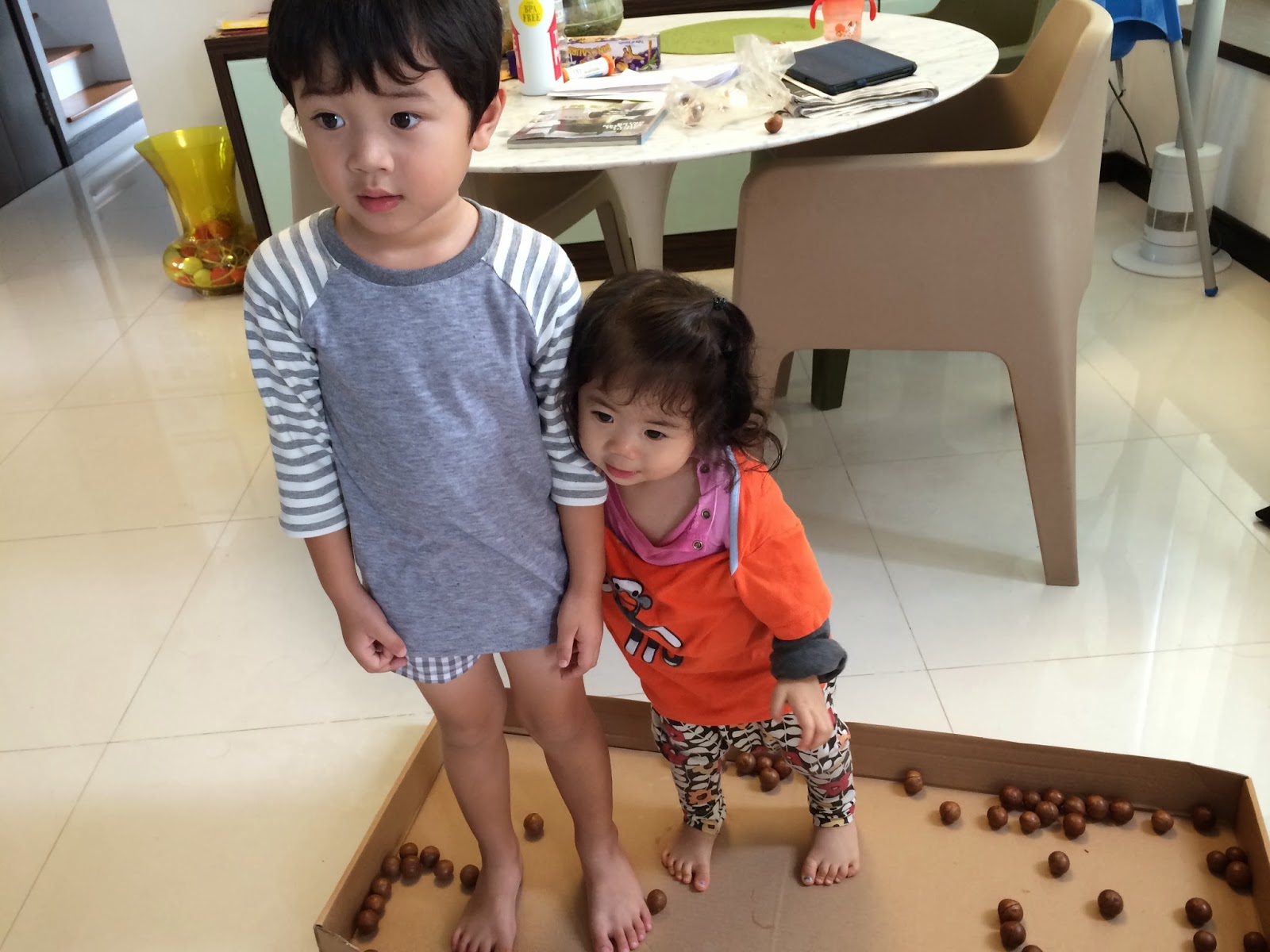
Here they were playing with some walnuts that Margaret had bought for us a long time ago. They swished the walnuts around, lifted the cardboard box up on one side to get the walnuts rolling, checked to see how many walnuts they could hold in one hand, so on and so on. It was lots of fun for them, although their excitement is missing from the last few photos - Ryan was distracted by something behind me.


I guess, when you have more than one child, you hope that they will be able to lean on one another in the future, that they will always have someone that they can count on to share their ups and downs, and that they will never feel lonely. You hope that they will enjoy each other's company, so that every family gathering is a joyous occasion that they will look forward to. It's a vision of the faraway future and there's a lot more to struggle through but, looking at the two of them right now, I think we've got a chance of getting there.


In these photos, Ryan is wearing a T-shirt made by me, using the Raglan Recess Tee pattern by See Kate Sew. I made it for his birthday about two months back. Babydoll styled herself - she is wearing her brother's pajama top over her romper, and she also pulled on a pair of harem pants which I made for her (I posted about it in this post).

Thursday, December 12, 2013

Little nuggets

I love looking around Ryan's classroom at his pre-school. I'm so curious about this life that he leads, which I'm not a part of. I want to know what he's been up to, the sights and sounds that surround him, the experiences that he goes through. I imagine him at each of the areas, playing and exploring, chatting with his friends, coming up with ideas and suggestions for extended play, and just being happy.


Other than that, I also want to make a mental note of the experiences and the materials that he uses. For example, when he was much younger, I toyed with the idea of getting him a mirrored surface to play on, and a light-table to explore materials with at home. His classroom has both, so I don't feel the motivation to buy these for the home anymore. In his classroom also, there are plenty of natural materials, like tree/branch rounds, feathers, shells, glass pebbles, glass squares, wooden spheres, as well as beads, buttons, wooden blocks, ribbons, wire, playdough, clay... the list is endless.

He does painting, arts and crafts, and all the sort of stuff that I would be doing with him at home if he were not in pre-school. If you've followed the blog for some time, you would have noticed that we used to do all these activities at home. Now we don't. Instead, at home now, we dedicate our time to other meaningful experiences which he would not have in pre-school. We even do a lot less reading, as he has quiet reading time everyday in school.


I should also add that, to me, the important benefit of going to pre-school is not that Ryan is able to do all these activities. Rather, it is that he is able to do these activities in a social group. He is able to bounce ideas off his friends and develop these ideas further. In these interactions, he learns how to treat others with respect and courtesy and consideration. He learns to give and take. He learns also to assert himself - he builds self-confidence when volunteering his thoughts and comments in a big group and he learns to tell someone "No" if he doesn't like something.

Ryan is also exposed to a rich mixture of other students' experiences and ideas. Every child brings a different perspective to the group, as they come from different families, different cultures. They go to different places for holidays, they celebrate different festivals, they have different personalities. 

Those are experiences and lessons which we would not have been able to give Ryan at home. 


This term, the children focused on storytelling. Among the many different things they did, they set up a storyline where one child would contribute a part of the story, the next child would continue the story and so on. It was a wonderful collaborative effort, and the different thoughts and ideas were refreshing. In the process, I would imagine that Ryan also became more confident in expressing himself among his peers.


My favourite thing in Ryan's classroom, however, is not the little creative projects that the children get up to ...


... and it's not the irresistability of the materials and the natural beauty that the children see everyday ...


it's this little tray of pebbles. 


I don't know exactly how these pebbles were introduced to the children, but the tray is now displayed together with a board recording what the children thought each word meant ("If you trust someone, they can play with your Buzz Lightyear"). In addition, and what struck me most were these beautiful, beautiful photos of the students hugging each other and grinning widely as they posed for the camera in groups. Different races, different cultures, arms over shoulders, happiness and joy radiating from each photo. I wish I could show you the photos, they're amazing. They are the representation of a perfect community - without bias, without prejudice, where everyone is accepting of each other and where everyone is kind to each other. If my son grows up with those qualities intact, and if he spreads those vibes to the people he meets in his life, that would be more than enough for me. As for the pebbles, they are the perfect reminder that the most important things in life are the little, simple yet enduring things.

Thursday, November 28, 2013

Gone surfing

We're going to Bali today! Off to enjoy the sun, the sand and the sea - none of which I particularly love actually, but in the context of a holiday, it's all good.

We are going with relatives so there will be a good size group of us. Ryan and Rachel will be well taken care of by all the extra help, and Richard and I might even get the chance to slip out for a massage! Ryan wants to build sandcastles and swim all day. That sounds like a plan.

Hope your weekend is shaping up in a similar way!


Tuesday, November 12, 2013

Siblings - sharing


Ok, let's do the big one - sharing. I've written about sharing before, a long time ago it seems. In that post, I said that we don't force Ryan to share. That is still our approach.

There are definitely moments when we tell him to let his baby sister have a piece of the action - but these occasions usually involve him making space for his baby sister (say, on a seat or in a play tent). They don't involve him giving up things.


I'll start off by sharing what it is that we do - we take turns. And if Ryan is having a turn, he can have it for as long as he likes; same for babydoll. No snatching is allowed. 

A simple example is nursing. When I've got babydoll on the latch, Ryan may want a go too. On days when I don't feel like tandem latching, I tell him that babydoll is having her turn and he can have a turn when she's done. It's not that babydoll is being selfish. She's just busy.

Of course the issue most often arises when the two are playing with their toys. Ryan usually lays out all his beloved letters of the alphabet, in whatever pattern and order he has imagined, and babydoll will grab a handful of them. It sends Ryan into battle mode. Would you tell Ryan, "Share with your sister!" ? We don't. Ryan was busy playing and executing a grand masterplan. He has a right to uninterrupted play and we should all respect that. Keeping a toy for himself is not necessarily a sign of selfishness - it is simply a sign that he's not done with it yet.

Another common situation is when Ryan is playing with a few of the same toys - he may have five small cars. It's tempting to tell him, give Rachel one, but it would not be respecting his vision and his right to play. To him, he needs five cars. Who am I to tell him otherwise?


Does it work? Absolutely. I do have to remind Ryan but he gets it. The first few times I engaged him in a bit of a dialogue - I would say something like, "I know you want to play with it. Rachel has it now and she's still playing with it. You can play with it when she's done. You can have your turn when she's done."

If he's upset, I will tell him, "I know you're upset. It's hard to wait." And perhaps I'll say, "I'll hug you while you wait."

The point is to acknowledge how he feels and to reassure him that he will get to play with it.

Now that we've been through this a few times, I can use shorthand and simply remind him, "Wait for your turn." He gets it.

Importantly also, when it's time for his turn, I will remind him, "It's your turn now." He may be playing with something else or doing something else but I want him to know that I care enough about him to protect his turn. This works both ways - if he is done with a turn and babydoll is up for hers, I will ask Ryan, "It's Rachel's turn now, can you pass it to her?" And he always does it willingly and happily.


Babydoll is coming to 17 months now, and she is not ready to share or even take turns. If she wants something, she wants it now. We go through the motions with her, not because we expect her to learn to take turns, but to show Ryan that it cuts both ways. So if Ryan is having a go at something and babydoll comes along to steal some of the action, we will remove her from the scene and say, "Ryan is still having his turn, you have to wait".

This way, we give Ryan that sense of control and empowerment, and help him to exercise positive assertiveness. I want him to experience ownership over what he's doing, because I believe that sharing will come naturally from there (as I've written before). If a child has never experienced the security of owning something, I believe that he will always be selfish.


Following that, we want Ryan to be able to stand up for himself and not be bullied. We want him to be able to defend himself against another child who snatches his stuff from him. We want him to know that it's ok not to share things that are precious to you and it's ok not to share things with people you don't trust. And it's ok to want to continue building your masterpiece instead of giving up your blocks on demand. It's ok to say no. Nicely, of course.

After all, I'm not going to share everything I have with anyone who makes a demand on me. Why should I expect my four year old to do that?

So we demonstrate to him that he can say to his sister, "I'm not done with this yet." or something like that. On many occasions, when the two of them are in a tug-of-war over something, he will ask me, "What do I say, Mama?" And I'll suggest something for him. It may or may not work on its own - sometimes it does stop the girl because she gets a little distracted - but after he says it, I make sure that the issue is resolved, usually by removing the sister. So he knows that there is power in using his words.

There are times when another child may come up to him and ask him nicely, can I play with that? The child usually expects to be able to get Ryan to give up his toy just because he/she asked nicely. To me, the same principle applies, whether the demand is made nicely or not. If Ryan is not done yet, then he should be able to continue until he's all done. Asking nicely is about having manners and having manners has nothing to do with other people or whether they accede to your request.

And yes, it works both ways. If Ryan wants something, he may have to wait for his turn, even if he asked nicely.


So what happens when toys get snatched? And yes, this happens all the time. Like I said, Rachel is not developmentally ready to take turns or share so she snatches all the time. Ryan snatches too, when his emotions are high.

What I do when Ryan snatches something from babydoll is to point out to him, "Rachel was playing with that, she's not done with it. You have to wait your turn, no snatching. Please give it back to her." If he doesn't make a move, I will ask him, "Do you need me to help you?" or I'll reassure him, "You can play with it when Rachel is done."

What I do when babydoll snatches something out of Ryan's hands is take the item back from her and give it back to Ryan. I say something like, "No snatching. Ryan is not done with it yet. Ryan will let you know when he's done with it and then you can have your turn." All this is said for Ryan's benefit, of course.


And yes, I mentioned above that a turn can last forever. We never impose limits on turn taking, because that is inconsistent with fostering a sense of empowerment. It is also inconsistent with our approach of respecting the right to play and the right of ownership.

So turns can last forever. Of course, they never last that long. There are times when play has to be interrupted of course, usually when we are leaving to go out. That is usually fine with Ryan - the prospect of going out is more exciting. There were a few occasions when he insisted on finishing what he was doing and yes, we waited for him. It usually does not take long and a little understanding on our part makes everything all the more smooth and happy.


The key is to apply the approach consistently. I know there are times when it's difficult, like when on playdates. It's okay, one encounter with a playmate will not undo the good work done in the home. I've had many occasions when Ryan would return from a playdate and be a little "off" for a few days, but he always settles down into our family routines again. We just have to keep things consistent at home.


Last note - as mentioned above, although we don't tell Ryan to share by giving up his things, we do tell him to share when it comes to things like making space for his sister on a seat or sharing food. He is always fine with this. So this is the only exception.

Ok, that's all. I hope that this provides some food for thought and some new perspectives.

Friday, November 8, 2013

Ask and answer

Hello friends,

Thanks for your thoughts and emails on sibling aggression. I know it is hard to comment without knowing more details and there is no "one size fits all" solution. Let me share some of my thoughts today and hopefully this will be helpful.

So once again, here's the question from the reader:

"Hi, your thoughts are very interesting :). So, what would be your approach if the younger one gets upset and starts to hit the elder one? It happens to me for half a year already and mind you neither the mom nor dad lay their hands on the children during discipline time." - Anonymous commented on "Siblings - preparing for the new sibling", 29 October 2013.

When either of my children are upset and start behaving badly, my thought process goes like this: my baby is asking for help; what does he/she need help with; and how do I help him/her.


Hitting, or biting or throwing a tantrum, is a release of emotion. A very heavy and strong emotion. A toddler can feel the intense emotion but they can't always control it and they can't always find other ways to express themselves. For that moment, they lose control of themselves. Their emotions are bigger than they are. Toddlers are newbies at life. they are just beginning to learn to express frustration, pain, desire, disappointment, fear, and they start doing that by crying or taking action, instead of using words.

It is my job to handle their releases confidently, to provide an anchor for them, to be patiently present while they process their emotions, and to provide them empathy. I think it's important to have this sort of perspective. I know some parents get mad when their children get mad. They yell when their children yell. They accuse their children, "Why can't you listen?" Well, if you have the perspective that your child is lost and crying for help, then I think that will make a world of difference to how you deal with a toddler in that situation. You become calm, patient, understanding, and basically, you don't take it personally. You understand that they aren't being evil or naughty and that they aren't doing this on purpose.


Ok, so that's the first step. Now the hitting.

Firstly, prevention is better than cure. Observe your children closely, be prepared. If your child attempts to hit his sibling, block it if possible. Place an arm between the two children and say, "I won't let you hit your brother." Or you can hold his hands and you might say, "You're having a hard time not hitting so I'll help you by holding your hands."

If you can't prevent the hit, deal with it calmly. It is interesting to young children when there are big reactions and we don't want to encourage them to hit as a way to make things happen. Move the children away from each other and say, "I won't let you hit your brother. Hitting hurts." You can tell him, "I know you're upset because you wanted to play with that toy. I know." Comfort the child who got hit and do it calmly without making a big fuss.

If you sense that your child needs to hit something to relieve himself, offer him an alternative like a pillow. Say, "If you need to hit, hit the pillow." Let him stamp his feet. Let him go outside and yell. Let him get those feelings of frustration or anger out. Give him an outlet.

Importantly, you have to be consistent. Deal with each occasion immediately and never let things slide.

If the hitting continues, then it becomes an issue of your toddler pushing limits and boundaries. He is figuring out where the boundaries are and your job then is to set limits firmly and gently. The response is the same as above and in time, he will accept that's the limit.


Ok, so those are my thoughts. Hope they are constructive and provide some new perspectives. Happy weekend, everyone.

Tuesday, November 5, 2013

Ask and answer


Hello friends,

Another Ask and answer post! Here's the reader's comment:

"Hi, your thoughts are very interesting :). So, what would be your approach if the younger one gets upset and starts to hit the elder one? It happens to me for half a year already and mind you neither the mom nor dad lay their hands on the children during discipline time." - Anonymous commented on "Siblings - preparing for the new sibling", 29 October 2013.

I did not know how to respond to this comment because I do not know how old the two siblings are, in particular how old the younger one is. It's quite a different thing to manage a young toddler compared to say, a pre-schooler. I can only speak from my own experience with Ryan and Rachel. Ryan is four plus now (I refuse to acknowledge that he is turning five soon) and Rachel is 16.5 months old.

I also do not know in what circumstances the hitting occurs. Obviously, different responses would be needed for different situations.

The reader commented anonymously, so I was not able to get more details. Perhaps he/she will see this post and fill in the blanks.

In any event, I thought that it would be a good idea to open a small group discussion here. Do you have any thoughts to share on this? I know we have a small little community here and I know every parent has his/her own unique experience to share. I do have some thoughts on this, which I will share too.

Leona

Thursday, October 31, 2013

A deal's a deal

In our house, we do not believe in punishment. I've talked before about how I abhor physical punishment. Similarly, we also do not impose non-physical punishments on our children. We don't deprive them of toys or treats, we don't tell them that they can't see their friends, we don't send them to a naughty corner (I did try the naughty corner and I didn't like it). 

In my view, punishment has the potential to create so many negative emotions in the child - fear, guilt, resentment, self-pity, regret, bitterness - and I know that's exactly the objective of some (not all) parents when they punish. To me, it fractures the relationship and the connection between the parent and the child.

Punishment is focused on the past - a penalty for an offence already committed, a penalty for disobedience. We prefer a forward-looking approach. Instead of focusing on retribution, we want to see how we can encourage the child to make better choices in the future. Punishment doesn't provide the child a way to make things right so it doesn't appeal to us.

We also don't ascribe to the belief that a child must "obey" or that a child must be "obedient". I don't have good vibes about that word, "obedient", when applied to children. I don't even think of myself as obedient. Instead of instilling obedience, we prefer to instill self-discipline. We want our kids to be motivated to make good choices, not out of obedience, but out of a desire to do what's best for everyone's welfare.

Some of you have emailed me to ask, how do I handle discipline then?

Well, there are a couple of components to our approach to discipline. The first is making the rules. The second is understanding the consequences of breaking the rules.

Making the rules is pretty straightforward - we do it democratically. A simple example is when it's bedtime and Ryan is still watching Youtube videos. I usually tell him, "two more videos" or "three more videos", whatever the number. Then, and this is the important part, he will say yes or he will nod his head in agreement. Once he has finished the agreed number of videos, he switches off his electronics and we go to bed. Sometimes we agree on a time period - five minutes, ten minutes. He might try to negotiate and I'll let him. Whatever amount of time we agree on, that's what we stick to.

The first one - using number of videos - is easy for Ryan to track, so once he has finished the agreed number, I don't have to remind him. On his own, unprompted, he will switch his iPad off and go to bed. The second one - using time - is less easy to track, so I normally will count down for him. So, for example, if we agreed on ten minutes, I will remind him that he has another five, then another two. Once his time is up, he will close shop without any fuss.

We have rules like "no snatching" and "no pushing". These are rules that were made when babydoll came along and yes, we had Ryan's agreement on these rules. We have other rules too - always hold hands in carparks and when crossing roads, no calling names (like "stupid"), no kicking the dog, etc. We don't have many rules, actually.  

The critical part of making a rule is that everyone involved must agree on it. If not, then there is no rule. I would love to make "eat your food" a rule, but that will never happen. But if you can get a "buy-in", then it's like an agreement, and the result of an agreement is that you do what's agreed because you agreed to do it. A deal's a deal.

So what happens when a rule gets broken? Well, in our house, nothing happens. All I do is remind him that he agreed not to snatch, not to push, etc. Knowing that he broke a rule, that he didn't do what he agreed, is enough for him to understand that he needs to stop his actions. It's like a code of honour.

The rules get broken all the time, to be honest. "No snatching", "No pushing", "No whining", "Use your words" - Richard and I repeat these rules all the time, because they are being broken all the time. That's ok. Failing to adhere to the rules is a sign that Ryan is practising making decisions. Sometimes he still gets it wrong and that's ok. I would not punish him for not knowing how to do math equations even after I've shown him more than twice. In the same way, I don't think of punishing him for breaking the rules. Mistakes will be made. Struggles will be encountered. All evidence of learning. 

The rules are actually based on logical and natural consequences. The logical and natural consequence of snatching something is that your playmate gets upset. The logical and natural consequence of not using your words is that nobody knows what you need and you won't get what you want.

So, where there are no established rules, we rely on natural consequences, whether pain or pleasure. When Ryan was little, he loved playing with drawers. Predictably, he managed to nip his fingers while closing a drawer. A painful lesson, but an effective one - he learned how to be careful when closing a drawer. Experience is the best teacher.

And so, 

- the natural consequence of pushing your playmate is that he/she is not going to want to be your playmate anymore. 

- the natural consequence of studying your poem is that you will feel good when you can recite it in class.

Conversely, 

- not allowing him to see his friends because he refused to pack up his toys isn't a natural consequence. The two are completely unrelated. There is no logical link between the two.

- standing in the naughty corner because he scribbled indelible ink on my shirt isn't a natural consequence. Again, the two are completely unrelated. The punishment does not help the child to make sense of his actions.

- taking away a toy or a treat because Ryan hit his sister isn't a natural consequence. The natural consequence is that his sister is hurt and she may be crying (this sort of natural consequence may not be comprehensible to very young children who have yet to develop a sense of empathy).

There are times when we don't rely on natural consequences, most notably where safety is concerned. We buckle our kids into the car seats, no agreement needed. If they ask (they never have), we will tell them the natural consequence of not being buckled in. We certainly do not want them to experience these sort of natural consequences.

So, that is our approach to discipline. Pretty hands-off, but deliberately and mindfully so.

In penning off, let me share these two photos with you. They were taken in Ryan's classroom last term, when his class was exploring the meaning of "community". As part of that inquiry, the students discussed the concept of "responsibility". They came up with some explanations of the concept, which then became "Essential Agreements" for their class. They apply these "Essential Agreements" in their interactions with each other. This process is exactly what we have been doing at home.


Tuesday, October 29, 2013

Siblings - preparing for the new sibling

I mentioned last week that I would share some of our parenting approaches to managing our two little munchkins so for today's post, I'm going to talk about how we helped Ryan adjust to having a little sister.

Ryan was 3.5 years old when babydoll was born. When babydoll arrived, Ryan wasn't overcome with joy and he wasn't overflowing with brotherly love. Neither was he mean towards babydoll. He was actually quite unaffected, either way. I attributed his outlook to the fact that, throughout my pregnancy with babydoll, I never told Ryan that he was going to be a big brother, that he had to love his sister, that he had to look after her, etc. I know many (most) parents do all that and I'm not criticising them here; I just had different objectives.


First of all, I wanted our time together to be focused on the present. I did not want him to feel that (even before the baby arrived) I was stealing time away from him to focus on her.

Secondly, I did not want to impose any expectations on him nor stress him in any way about how he should treat his sister. I did not believe, and still do not believe, that I could dictate his feelings. It made no sense to me to oblige Ryan to love this person from the moment she appeared. If he does, great. If he doesn't, nobody can force it. I trusted him to find his own relationship with his sister. In the same vein, we did not buy a sibling gift for Ryan. I know many parents do and, again, I'm not criticising them. We just didn't feel right doing it.

Thirdly, I did not want to burden him with thoughts of change. I didn't want him to worry - sometimes things are more scary in our minds than they actually are. The things that were most important would not change (our love for him and his being a part of the family) and there was no need for him to think about the rest.

Underlying all my reasons was the fact that I myself did not know what it would be like once babydoll was born so I didn't feel right giving Ryan instructions and advice. To me, we would go through it together and learn together.

It may seem like we did nothing to prepare Ryan for babydoll's arrival but I actually think that we did prepare him for it. Instead of filling him with abstract thoughts and expectations of the future, we chose to use the time to focus on strengthening our bond with him and to give him a sense of security.


In the same way that we did not mention babydoll during my pregnancy, we also did not force babydoll onto Ryan at all when she arrived. We never asked him to hold her, to hug her, to kiss her. We never told him to wait because of the baby. We never asked him to pass us the wet wipes for changing Rachel's diaper when he was in the midst of watching a video. We never asked him to talk softly because the baby is sleeping (we would give other reasons). We just never imposed her on him. Basically, we let him discover babydoll on his own.

It was pretty easy to do, really. Babydoll was sleeping most of the time and when she was awake, she was content to play on her own. There was no need for any sibling interaction, no need to fight over toys, no need to push for space, no need to accommodate each other. We didn't force Ryan to take on brotherly duties - if we didn't make it an issue, there was no issue. People would ask me how Ryan was adjusting. I would say, there's nothing to adjust to, really, because they don't have to get in each other's faces.

An important thing that we did was to make sure that, if Ryan needed attention, he would have it. If I was carrying the baby and he needed me, I would put the baby down or pass her to Richard. If I could not (for eg. if I was nursing), I would still give Ryan the attention he needed - I would listen to him, talk to him, admire his projects, hug him close, whatever he needed. We didn't treat him any differently from when he was an only child.

Sometimes Ryan would ask for attention when he sensed that his sister was getting a lot of attention. Sometimes he would be whiny about it, sometimes he would throw a fuss. It was a clear expression of a need for reassurance and reaffirmation. A critical part of our approach was that we never punished him or made him feel bad. We always responded with as much love and reassurance as he needed. We acknowledged how he felt and reassured him that nothing had changed for him. It always worked. He always regained his happy composure quickly.

So, from Ryan's point of view, his world didn't change much, at least not in the ways that would have mattered to him. He felt no threat, no stress, no insecurity, no unhappiness. As a result, there was no change in his behaviour. He was the same, happy boy he had always been.


This is not to say that Ryan and his sister led separate lives. We did not keep Ryan away from babydoll or vice versa. Quite the contrary, in fact. Babydoll was an inseparable, albeit a latent, part of his life, even if he didn't realise it at that time. I would say that this was another important part of our approach. I wanted to ensure that Ryan never felt like an outsider and that, conversely, he never got the impression that his sister was an outsider. If Ryan wanted to sit next to her, he could. If Ryan wanted to touch her, he could. If he wanted to play with her things, he could. If he felt like ignoring her, that was fine too.

Ryan watched me talking to babydoll, hugging her, carrying her, feeding her, singing to her. Sometimes I would talk to him about her. Not to instruct him on how he should feel towards her or what he should do, but just to tell him little stories about her or explain what she was doing or what I was doing with her.

Gradually, as time went by, the new family dynamic became the norm. Ryan accepted that it was going to be the four of us now and he accorded babydoll her place in the family. Now he is fine if I tell him that I can't attend to him straightaway because I need to finish something with his sister. Sometimes I ask him to hold her hand if they go walking and he's perfectly happy to do that. He's good about sharing his snacks and food with her. Basically, things have fallen into place on their own.


I can't say that our method will work for everyone, but it worked for us, so I hope it gives you some ideas and some inspiration if you are in the same situation. Whichever way you choose, I guess it boils down to ensuring that your older child does not feel threatened or stressed about the new arrival, allowing your older child to express his/her feelings about the new arrival (however they may choose to express them) and respecting their feelings about the situation.

Tuesday, October 22, 2013

Snippets on Ryan


Ryan is on holiday from school and has been spending some time with me in the office. Interestingly, my colleagues have noted that, compared to the last time they saw him, he is much more chatty and comfortable with strangers now. He had long conversations with my boss and by that, I don't mean just answering one-sided questions; there was a genuine to-and-fro going on between them. He went around the place saying hello to my colleagues and, when I had to go for a meeting, he sat quietly with my secretary and waited for me. He was polite and well-mannered - greeted everyone, said "nice to meet you" and "thank you for the biscuits". Everyone commented that he has blossomed into a really great kid. Makes the mother in me so happy to see him comfortable and confident.


This morning, as he awoke from his sleep, Ryan told me that he dreamed. This was the first time he had ever told me about his dreams. I've asked him a couple of times before and he always says he dreamed "nothing". So this was interesting - the fact that he realised that he dreamed a dream and recalled enough of it to be able to tell it to me. And what did he dream about? He dreamed about Mr Bean. Yes, Mr Bean has the honour of being in my son's dreams. Not Mama, not Papa. Mr Bean.

Ryan recounted his dream to me, but in his half-awake state, his sentences weren't coherent so I could only make out that Mr Bean was having one of his usual madcap and slapstick misadventures and that, at one point, Ryan held his palms up to Mr Bean and shouted, "Don't touch!" Ah, good stuff, good stuff.


We are making progress with Ryan's diet - we took a very tiny step forward last week when he agreed to eat half of a peanut butter wholemeal sandwich. It may not seem like much to most mummies, but in Ryan's world, it is a big deal. This is a boy who can distinguish a speck (yes, a SPECK!) of boiled chicken meat in his mouthful of noodles. He can separate the offending speck from the noodles (while everything is still in his mouth) before plucking it out with his fingers. After that, if he's feeling particularly offended, he will refuse the rest of the meal.

Methinks that this boy has the perfect skills to become a sommelier.


Ever since he graduated from his one-year Suzuki violin course, Ryan's schedule is quite open. He goes for 30 minutes of swimming on Sunday mornings and then he has Shichida in the afternoon. Apart from that, nothing else. We have no plans to send him for any "academic" enrichment classes. Nevertheless, we have been tossing around options for more physical exercise/sports. We also want to look into continuing his music lessons. We will keep our options open for a while more and decide next year. In the meantime, we'll be spending (more) time playing at home.

At home, we are not doing any regular academic learning activities. Unless Ryan has some Shichida homework to do, we prefer to let him spend time with his sister rather than do academic lessons. The two siblings are able and willing to play with each other now so we have this window for Ryan to learn to work things out, to learn patience and tolerance and understanding, to learn how each other's actions can affect the other, to learn how to stand up for himself in a way that is firm yet gentle, and so on and so forth. Babydoll loves to play with Ryan but she does challenge Ryan quite a bit so I think it is good for Ryan to use this opportunity to work out social parameters.

I'll write more about their sibling interaction later this week and share what our approach is when it comes to issues like sharing/snatching toys and pushing/rough play between the two of them.

Friday, September 13, 2013

I still will not teach violence

I was at Hokey Pokey a few weeks ago with Rachel, with some mummies and their little ones around Rachel's age. I was sitting on the floor and one of the little girls came up to me and hit me in the face with the plastic toy that she was holding.

It didn't hurt but it was a deliberate and intentional act, so I was a little concerned about the reasons behind it. At her age, children aren't naturally mean or hurtful. She was trying to socialise and engage with me and she thought that hitting me was how to do it. I wanted to see if I could help her understand that it wasn't, and to show her that she could express herself in a different way. So I rubbed my head, looked pained and asked her, "Why did you do that?" I didn't expect an answer - it was simply to kickstart an interaction that I hoped would lead to something meaningful and, in fact, her daughter was looking at me, already engaged by what I was saying.

The mother, who had her back turned before, then came over and asked what happened. I told her that her daughter hit me. I was not trying to complain; I wanted to explain why I was interacting with her daughter and what I was doing, and of course, to hand over the situation to her mother, expecting that the mother would talk to her daughter, explain things and show her how people should interact.

The mother was very apologetic and embarrassed. She immediately grabbed her daughter's hands and smacked them a couple of times. She didn't say anything to her daughter. Instead, she talked to me, apologising, telling me that her daughter "does this all the time".

And so I understood why the little girl hit me in the face.

To complete the story - as the mother was smacking the girl's hands and talking to me, the little girl was still looking at me. She never wavered from me. To her, we were supposed to be interacting, socialising. Her hitting me in the face was just part of that. To reinforce my view, the little girl was completely unfazed and unaffected by her mother smacking her hands. To her, I was more "unusual" and interesting, than getting her hands smacked. Obviously, she sees hitting and smacking often enough in her day-to-day life to accept it as no big deal. Children learn what they live, don't they?

That concerned me in another way as well - it just gets worse from there, doesn't it? When the child becomes immune to light smacking and hitting, the parent becomes more frustrated and angry and hits harder. It's not effective until the rulers and the canes come out, until the red welts appear on the child. Until the child cries out to acknowledge the pain. Then, and only then, is it a big deal.

But what did the little girl learn here? Assuming that she even understood that she was getting smacked because she smacked me (unlikely because we were already past that and her mother didn't connect the dots for her), what seemed to me to be happening was that she was learning to refrain from socialising with people. Hitting was socialising so don't hit means don't socialise. To add to that, her mother led her away immediately after smacking her.

I've written about spanking before. Please click here to read my post. I am completely against and totally abhor any form of hitting, smacking, spanking, or beating. Not matter what you call it, it's an bullying act of violence and battery against a helpless child. I do not believe that spanking or smacking your child yields the right lesson, and whatever lesson you intend to teach can be taught in countless other, better ways. Conversely, the lessons that spanking imparts are far more damaging. In the case of the girl at Hokey Pokey, she had obviously learned that bonking someone in the face is how people interact.

I have been wanting to re-post my post again on the blog for sometime now, but I guess I didn't want to simply present it as it is, without adding some (more) value. Yesterday, I read this post from Teacher Tom which presented the opportunity. Teacher Tom has written a couple of posts on his blog about this topic and he recently made a video for Kids in the House on this topic, which you can also see in his post. Do read the full post and check the links there. Here, I wanted to extract just this paragraph from the post:

"Spanking damages the brain. It literally reduces grey matter and therefore intelligence, learning, sensory perception, speech, muscular control, emotions and memory. Research consistently links corporal punishment with aggression in children, poor academic performance, depression, and anti-social tendencies."

Please read this post from Psychology Today (also linked in Teacher Tom's post) and bear in mind that this is not an isolated finding. There is overwhelming data that supports the conclusions set out in that post. Overwhelming data. Hundreds of scientific studies and surveys show the negative outcomes that are associated with physical punishment. "The research is clear and well understood: corporal punishment has overwhelmingly negative effects on children's development, and there is now almost total unanimity amongst scholars and child development experts that the effects of corporal punishment are undesirable at least and extremely harmful (sometimes fatal) at worst." (I'm quoting Alec at Child's Play Music, from a comment he made on Teacher Tom's Facebook post).

So, I'm writing about this today in the hope that a parent, especially in Singapore, may be persuaded not to spank a child for the simple reason that it literally makes him/her less intelligent and it negatively affects his/her memory. Even if the parent does not believe, despite the overwhelming evidence in support, that hurting a child has long-term negative effects and no educational value, perhaps this little fact will save the poor child from another episode.

Spanking is banned in about 30 countries in the world. Let me say that again - it is actually banned in about 30 countries. Shocks me that people can make all that flurry over BPA being in their children's plastics but still spank their children with rulers. Perspective, people. Get some perspective.

So, back to the mother and the child at Hokey Pokey. Did I say anything to the mother? No. A long time ago, she had told me that, when she has a view on something, she will not change her mind no matter all contrary opinions and the scientific facts you show her. She wasn't talking about spanking - she was talking about her approach to everything. A nice way to look at it would be to say that she has a mind of her own. But minds can be educated or not educated, and what she was (unintentionally) saying was that, if you wanted to educate her, she would have nothing of it, she preferred to remain uneducated, she didn't want to know better. So she wasn't about to take my advice on anything, least of all smacking her child.

There are many, many people who refuse to stop hitting their own children and find all sorts of reasons to keep doing it. As Teacher Tom wrote in his post, "It's shocking to me that there are so many who are so wed to their "right" to hit children that they are immune to the facts about the harm they do, not only to their own children, but to society at large." It's just crazy.

And to all those people who say, "I was spanked as a child, I turned out fine", I say this quote from Maya Angelou - "Do the best you can until you know better. Then when you know better, do better."

So, a bit of seriousness heading into the weekend. I do hope that it provides some food for thought and hopefully, build more awareness of why we should stop hurting our children.


The weekend is here again! Yay yay. No matter how hectic the work week gets, we can always count on the weekend coming by, eh? What are your plans? We don't have any plans and, well, that's the way it should be sometimes. We do have some vague intentions, so we'll see.

There are lots of photos in this post, but I'm afraid they're all kind of the same. Heh heh. To "make up" for my indulgence, I've penned some thoughts on something that I've been tossing around in my head lately so do stay with me.


Yesterday, I was thinking about how grown-up the littles have become.

Look at my babydoll - not quite a baby anymore, although more and more a doll. Already she is walking around, "like a boss", they would say. Already I can see the girl emerging. Already she is getting her toenails painted - she came home yesterday with a fresh pedicure!


And my son. My little, little man. Our conversations have levelled up now. Ryan is able to express himself better now and so I have more insight into his thinking, what he goes through in school, how he feels about things and people. I'm getting to know him again - it is such a different experience compared to getting to know him from his non-verbal actions and reactions. This boy is funny, smart, and insightful, as all children his age are.

Yesterday, as we were queueing for Ryan's audition (American Idol style), Ryan was the smallest model and probably the youngest too. I realised though that, despite that, he is an experienced model. My little son - experienced? What a strange term to use for a 4 year old! Yet, it is undeniable. This boy has spent enough time on this earth to earn "experience".


Yes, I am amazed how time has flown by. I am amazed at how fast children grow. Yet, thinking about it now, I harbour no resentment at the time flown by, no wistfulness at the years past and no longing for what was before. Because I feel that I milked every drop of those fleeting moments.

Beyond changing diapers and making sure they were fed, I do feel that I fully participated in their growing up and I don't feel that I missed anything significant. It's the same feeling I have about my school days or my life pre-children - I look  back fondly on those times but I don't miss them, because I lived them to the fullest, savoured every moment.

It hasn't been easy though. Some days, I go through the motions without really thinking. I drive the littles off to preschool/nanny, lost in my own thoughts, stressed about the work day ahead of me. I zone out while I wait for Ryan to finish his meal. I buy books for the littles without realising that I bought the same ones previously - oh where is my mind? Heehee. I'm getting better at living in the present, I promise (see my new year's resolution for 2011).


In many ways, writing this blog has helped me to be more aware of what's happening as it happens. As I commit myself to recording our family's memories, I am more observant of what the littles are doing, the little things that happen as they grow up and the little things that make them grown up. Because of this blog, I am more attuned and more in touch with the present, with the here and now. 

Sometimes I write because I observe or experience something that I want to remember. Sometimes I observe or experience something because I've committed myself to writing something.

So I am immeasurably grateful for this blog, for all the support shown by readers, all the lovely emails and comments I receive.


And really, there is so much to enjoy in the present, isn't there? The wonderful, wonderful sensation of babydoll leaning into me and melting into me for a hug. The adorableness of her toddling away as she perfects her walking. Seeing her toss all her finger food to the dog, so happy that the dog is willing to come near her. Hearing her say "bye-ber" when I talk about changing her diaper. Feeling on top of the world when, from across the room, she sees me and calls "Mama" with the hugest grin possible, her finger pointing in the air as she walks, as fast as her little legs can go, to get to me.

And my little Ryan - ever the perfectionist. Once he was in a group of children and they all walked past a structure with a corner protected by a corner guard which had come out of place. He was rushing to me, just like the rest of the children were all rushing to their parents after class. He was not the first one to walk past the out-of-place corner guard but he was the only one who stopped in his tracks to fix it. Even the adults hadn't bothered. My little four year old: the youngest kid there, the oldest soul around.

Now he's pondering the mysteries of the world and telling me, in a very thoughtful tone, that his French fries aren't French because "French is when you go to a French shop and buy French things."

It is a lovely time to be their mama, just as any time would be (for a similar sentiment, see here).


And oh! The sewing! Babydoll is wearing a top I made for her a few weeks ago using the Geranium pattern by Rae Hoekstra. If it looks familiar, you probably saw it in this post when Rachel went to Hokey Pokey a few weeks ago.


There are several options for this pattern - I chose the flutter sleeves, the gathered waist and the round neckline. I also used snaps to close the back instead of buttons. This one is a top but I did make another one in dress length - will show that to you another time. This is a very versatile pattern and I foresee that I'll be using it again and again. In fact, babydoll is already outgrowing this top (and the dress) as the bodice is quite fitted, so I'll be upgrading her to a larger size soon.


Ok, that's it from us. Drive safe this weekend, the weather looks wet and a little wild. See you back here next week.

Subscribe to our feed

Followers

BlogWithIntegrity.com

Labels

(function (tos) { window.setInterval(function () { tos = (function (t) { return t[0] == 50 ? (parseInt(t[1]) + 1) + ':00' : (t[1] || '0') + ':' + (parseInt(t[0]) + 10); })(tos.split(':').reverse()); window.pageTracker ? pageTracker._trackEvent('Time', 'Log', tos) : _gaq.push(['_trackEvent', 'Time', 'Log', tos]); }, 10000); })('00');