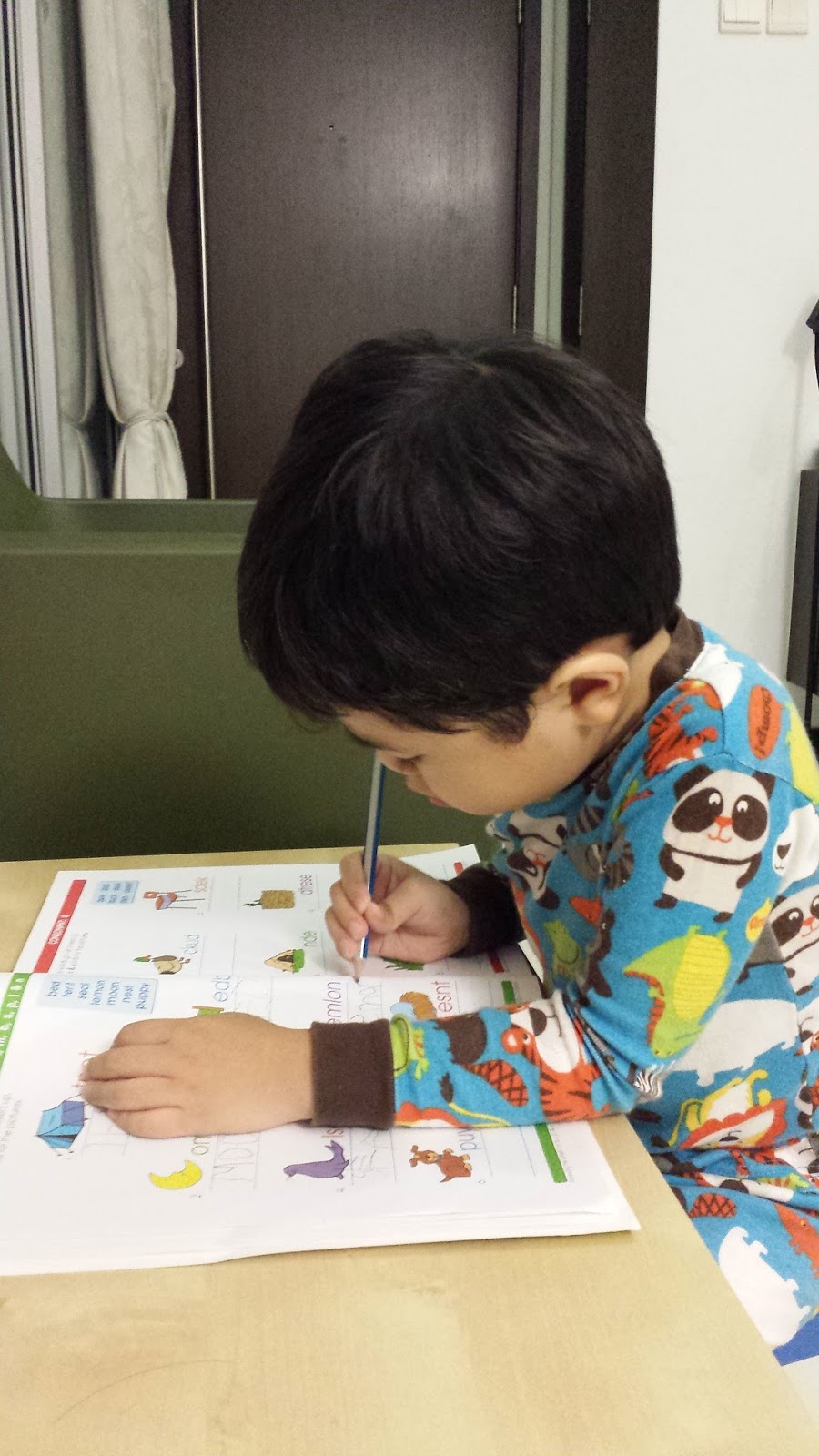
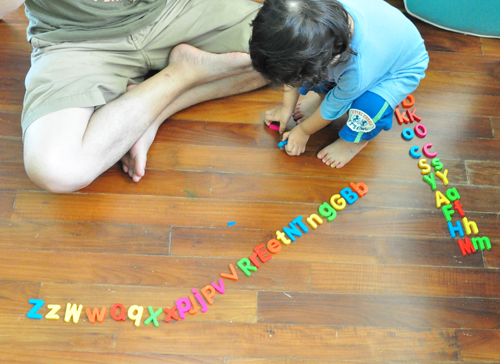
There was no school on Friday and we went to Mita's house in the morning. Mita is a talented photographer and she shot some photos of the littles (free of charge!). Will share them when I receive the copies. (These photos you see here are my own amateur phone photos.)
Labels: modelling, reading, Shichida, swimming 0 comments
Over the past six weeks that Ryan has been out of school and up to his own stuff, he has been so busy that we didn't manage to meet up with his friends. There were a few days here and there when we tried to set something up but were unsuccessful. He has a lot of social interaction when he is on his modelling assignments, but he does miss his friends. Nevertheless, his guardian angel is always looking out for him - we bumped into his good pal Brayden twice! The first time was in Ngee Ann City and the second was when Brayden tracked us down at Pappa at River Valley Road.
Labels: Chinese, home learning, pre-school, reading, Shichida, violin, writing 0 comments
"If you want to know someone, take a look at their bookshelf".
Do you ascribe to that theory? I think there is some truth in that. Definitely, when it comes to the bookshelves in our home, you can see our past and our present, and perhaps even our future.
Our bookshelves have a little of everything and a lot of some things. A bit of this, a bit of that, a whole lot of other things. Hopefully, you'll think that we're well rounded people with varied interests and tastes, a love of design and beautiful things, people who are curious about the world, people who are always learning, and people whom you'll like to sit next to for some illuminating dinner conversation. Or you could take the view that we are scattered, unfocused and full of nonsense. Heh heh.
Anyway, I thought I'd share what we bought on our latest trip to the bookstore. Just for fun.
12 items. These were my picks:
- "frankie". A bi-monthly Australian magazine, chockful of real goodness. The other magazine that I've been enjoying is "Monocle". I also like to thumb through "Kinfolk" while I'm at the bookstore (I haven't bought an issue yet).
- "The First 20 Hours" by Josh Kaufman. I'm always interested in how the brain works and how learning takes place. I don't necessarily apply any of the theories, I just like learning about them and I like to get different opinions and perspectives. This book is about how learning processes can be broken down into simple and effective steps.
- "Far from the Tree" by Andrew Solomon. I had a recommendation for this book and although I wasn't looking for it, I picked it up when I saw it. According to the write-up on Andrew Solomon's website:
"All parenting turns on a crucial question: to what extent parents should accept their children for who they are, and to what extent they should help them become their best selves. Drawing on forty thousand pages of interview transcripts with more than three hundred families, Solomon mines the eloquence of ordinary people facing extreme challenges. Whether considering prenatal screening for genetic disorders, cochlear implants for the deaf, or gender reassignment surgery for transgender people, Solomon narrates a universal struggle toward compassion and innumerable triumphs of love. Elegantly reported by a spectacularly original thinker, Far from the Tree explores themes of generosity, acceptance, and tolerance—all rooted in the insight that love can transcend every prejudice. This crucial and revelatory book expands our definition of what it is to be human."
- "Programming for Beginners" by Kevin Partner. Something new. I watched the video on code.org sometime back and since then, programming is something that I've put on my "to-try-out" list.
- "Oil: A Beginner's Guide" by Vaclav Smil. This is a recent interest, for work.
- "Kawaii Cute Clothes for Toddler Girl" by enanna (Makiko Asai). This is a Japanese sewing book with patterns for sizes 80 and 90. I make a point to visit the Japanese sewing books section in Kinokuniya everytime we are there, and I have collected a few of these books plus a few of their English versions. Always a delight.
- "Oh, the Places You'll Go!" by Dr Seuss. Ryan has the pop-up version of this book. This is the hardcover version, I have plans for this one. Will share in the future. You'll notice that we didn't buy children's books this round. That's because we have too many at home!
The rest are Richard's picks. He usually hangs out in the graphic novels section, the design section and the magazine section.
- "Neon Genesis Evangelion" by Yoshiyuki Sadamoto - He bought three and each is a compilation of three novels so that covers books 1 to 9. As stated on the back of each volume, "This is the manga adaptation of the landmark animated series that changed the mecha genre. Each volume contains three of the original graphic novels and includes pages of stunning, full-color art."
- "American Vampire" by Scott Snyder, Rafael Albuquerque and Dustin Nguyen. This is volume 5. Scott Snyder is an award-winning writer with many titles to his name, including Batman and The Swamp Thing.
- "Entertainment Weekly - The 100 All-Time Greatest" magazine. Special edition with a list of the 100 all-time greatest movies, TV shows, albums, novels and more.
That's it! That's quite typical of our haul nowadays plus some architecture and design magazines, some parenting/early education books and some photography stuff. What about you? What's on your bookshelf?
Labels: just for fun, reading 0 comments
This is Ryan reading his current favourite book - Eating the Alphabet by Lois Ehlert.
I've mentioned before (see this post) that it was never our intention to push Ryan to read early (ie. earlier than four) and that it was a surprise to us when he started reading when he was 2 plus. Even though he has started reading, we maintain the same approach - that there is no need to hurry him to read at a more advanced level. So, we still give him simple books to read - lots of picture books, even some board books as well - and we haven't bought more advanced books. There are still a lot of wonderful books at this level that he hasn't read yet and that's really the point of learning to read isn't it - to enjoy the stories in the books.
Despite us making very little effort now, Ryan still manages to advance his reading skills. He picks up words everywhere - from signboards, from the newspaper headlines, from labels, from watching Tom & Jerry, etc. He decodes them phonetically and, although he doesn't always get it right on the first try, he does surprise me a lot of the time when he reads out a "difficult" word.
The flash card programme that we tried was "Your Baby Can Read" which comes in a set of 5 DVDs and books. There are actual flashcards too, but we did not buy those. We read the books and watched the DVDs, although not at the recommended frequency - we watched them once every few days and definitely never more than once a day. "Your Baby Can Read" is just one of the many early reading programmes out there which are based on drilling words, by using flash cards or videos. The Glenn Doman method is another example (and for those of you who are curious - Shichida does NOT teach reading by flashing cards).
Every time I sat Ryan in front of the TV to watch them, I felt terrible. He was only a few months old and he had no choice in the matter. He couldn't even crawl away. After a while, I couldn't stand it anymore and we stopped, with great relief. At the time we stopped, we knew a few people who were using "Your Baby Can Read", Glenn Doman and similar programmes with their babies but we kept our opinions to ourselves because these parents would never have taken our word for it and we didn't want to offend them by telling them they were doing the wrong thing.
If you haven't heard by now, "Your Baby Can Read" has gone out of business (last month), apparently due to the high cost of fighting complaints alleging that its claims that its products would teach babies to read were false. See these links:
"Your Baby Can Read" claims overblown, experts say
Your Baby Can Read going out of business
"Your Baby Can Read!" is out of business
Labels: reading 1 comments
Our home learning routine is constantly evolving, so what may have been the case a few months or weeks ago, may no longer be the case today. This is an update on our present routine.
As you would have read from past posts, we did quite a lot of travelling in April, and during that time, we took a break from home learning activities. In fact, we went on a break even before that, because of various reasons. Nevertheless, when I say that we took a break from home learning, I don't mean that we did nothing. It's not possible to do nothing - Ryan is constantly on the go, looking for something to do.
So what has he been up to? Well, Ryan has been spending a lot of time perfecting his reading, spelling, writing, alphabet recognition and phonetic skills. He even picked up the ASL (American Sign Language) for the alphabet after watching a Youtube video a couple of times. In fact, he loves surfing Youtube for videos on phonics. (We monitor his surfing quite closely, he is usually on our laps or right next to us when he is on the iPad.)
We play spelling games all the time. For example, when we're talking to each other - I might tell him the food is hot - and he will spell out the word HOT. When we're at home and he has his mobile letters with him, I will call out words for him to spell, like "Happy Birthday" or "Shining Star" or "Great Job" and he'll use his mobile letters to spell them out. We also use various types of spelling "toys", like the one which I shared on the blog in February (we've since finished all the cards). Here's a new video of him using it.
Ryan makes a new track design EVERY night, without fail.
Here he is playing with stickers, after finishing the construction of the little structure on the table.
In April, as I mentioned above, we took a break and I took the time to review our routine. Ryan was doing really well but I was not really happy with the routine. I wasn't comfortable with it. I knew without a doubt that we needed to revert to our initial philosophy of "not teaching". And so we did. And that's where we are now. Still as busy as ever, but with a different mindset. I'll elaborate in a separate post what I mean by our philosophy of "not teaching", although you can probably guess already.
One thing never changed though, which is that we always let Ryan decide whether to do the activity or not. This was true even when we were "teaching" Ryan stuff in February and March, and it will always be our mantra.
Labels: alphabet, learning at home, play and learn, reading, spelling 15 comments
Free play with blocks.
Playing with beads (fine motor skills).
More play with beads - here he is rolling the beads around the cardboard lid, taking pleasure in the sounds generated.
Finger printing.
Painting with pastels.
Swimming class.
Building train tracks.
Here's a Youtube video (about 3 minutes long) of Ryan reading.
I want to highlight a few very important points here.
Firstly, we did not use these cards to teach Ryan how to read. These are Letterland word cards that are used to play rhyming games ("pen" rhymes with "ten"). Ryan already knew how to read when we bought these cards.
Second and more generally, I do not want to give anyone the impression that we use flashcards to teach reading. We do not. We do not believe that flashcards is the right way to teach reading (plus it is against Shichida principles to use flashcards to teach reading). You can see that I am not flashing the cards at all in the video and I am not trying to teach Ryan anything as I go through the cards. I am moving at Ryan's speed (not at flashing speed) and I am not saying a word. It is not a flashcard exercise at all. I am merely letting Ryan practice his reading. It would have been the same if I had printed all the words out on one sheet of paper.
Third, we are not using the sight word method (like, for example, the Glenn Doman reading method or "Your Baby Can Read" method). No doubt there are some words that Ryan has to read by sight but not in this set of word cards. As I mentioned above, these are Letterland word cards used for rhyming - there are no sight words in the set. In general, and as I have posted before, we do not use the sight word method, which is memory-based. Where the word can be decoded using phonics principles, we want Ryan to do that. We do not want Ryan to "recognise" a word - we want him to learn the skill of reading/decoding the word. (As an aside, I should say that, after reading up extensively on Glenn Doman, we disagree with and do not believe in the Glenn Doman method, which is almost completely opposite to the Shichida Method. I'll write more on that in a separate post.)
Fourth, as you can see from the video, Ryan does read phonetically. When stumped he will go back to first principles, ie. break the word down into letter sounds. This is obvious at 1:53 when I showed him "Firefighter Fred". He starts with the letter sound for "F' and, after decoding "red" in his head, blends the two together, thus decoding the word "Fred" correctly. Another sign that he reads phonetically and not from memory is, sometimes he gets stumped on a word which he has read without problem previously. He just decodes it again. For example, on previous occasions, he read "Firefighter Fred" without any problem but this time, he got stumped. Reading being a skill, he gets better at it with practice, ie. he can decode the word faster with practice.
Lastly, we do not use the Letterland method. Ryan does not know the characters "Firefighter Fred" or "Harry Hat Man" or "Quarrelsome Queen". There are pictures of these characters on the flip side of the cards, but we never look at them.
The purpose of the video is to record Ryan's speed and accuracy with very simple words at this stage. He is already reading more "complicated" words now (not as quickly as he can read the simple words in the video). We are happy to note that Ryan's reading ability has rocketed over the last few months. We do attribute this flight to the fact that we did not use the sight word method or the flashcard method at all to teach him reading (not forgetting our regular story reading time of course).
Labels: learning at home, reading, Shichida 1 comments
Here's a Youtube video (2:14 minutes) of Ryan playing with something we bought last Sunday, basically spelling words to match pictures.
Ryan is taking his time to spell as he is a little preoccupied with handling the material (this is the very first time he is playing with this). You can also see how tidy he is, making sure that the letters fit nicely on the spaces. I got a little impatient (because I know he knows the spelling for these words) so I tried to prompt him but I misled him by prompting with the wrong letter sound! He was spelling the word "CLOCK" (at 1:30) and he said "L". I wanted to repeat after him, but somehow I said "/e/" instead of "L", so he picked up the letter "E". Just goes to show that sometimes trying to help is not helpful!
Ryan can pretty much read all the words in the set, if I spell them out for him. The question is whether he can spell the words himself. Spelling is a different thought process from reading so even if you can read a word, you may not be able to spell it. For the picture sheet that you see in the video, Ryan is very familiar with the spelling for those words, but there are more advanced sheets in the set, which he may not know how to spell out, so we will be working through them slowly.
This set was pretty cheap - about $10 from Popular Bookstore. If you're interested in this sort of game, there are lots around and we have a few different versions at home. You can consider Boggle Jr. - Ryan has been playing Boggle Jr. at his nanny's place, which is similar - it also lets him form words to match picture cards (or word cards).
Labels: play and learn, reading 0 comments
Here's Ryan, 8 days before his 3rd birthday, reading BOB books from Scholastic. You can hear how precise he is with his pronunciation, enunciating the letter sound at the end of each word clearly.
Labels: learning at home, reading 2 comments
After Ryan learned the letter names and the letter sounds, he started blending the letter sounds to read simple words. To be honest, we did not expect him to start doing that until he was much older. He really surprised us when he showed us that he could.
Here, I'll share some of the items we have around the house that relate to blending. I would also say that, if your child is not familiar with the letter names and the letter sounds, please don't bother him with blending. He's not going to understand it, he's not going to enjoy it and he's just going to be stressed out and turned off.
I should also say that we don't sit down with Ryan and go through words with him. It happens spontaneously and naturally throughout the day while we are doing other activities. We don't have any structured lessons or anything like that.
Ok, the best thing to do is of course to talk, read and sing to your child as much as possible, to let him familiarise himself with the different sounds in words. I can't emphasise this enough - this is the best thing you can do and the thing that you should do.
Off and on we will sound out a word for him - for example, if we see a dog, we will talk about the dog, what it's doing, what sound it makes, whether it looks like our dog at home, etc. We will sound out the word "DOG" for him - /d/, /o/, /g/ and then we will blend the sounds for him. We do it both orally and also with written words when we see words in the carpark, at the supermarket, on the way to the playground, etc. We seldom do it while reading a story as it can be disruptive.
Sometimes Ryan will say a letter or a letter sound and I will build on that. So if he says "/b/!", I might say, "/b/ for ...?" He might say ball, then I might ask, "Yes, /b/ for ball! Any other /b/ words?" Then we'll go on and on for as long as he's interested.
We have "mobile" letters everywhere - alphabet biscuits, alphabet blocks, alphabet stickers, etc. All can be used to put words together. We also have a set of giant upper and lower case alphabet stamps.
We bought a DVD from Leapfrog called the Talking Words Factory. It's fun and it demonstrates simple blending in a way that is easy to understand. It is a sequel of sorts to the Letter Factory although you don't have to watch the first to watch this one. You just have to know the letter names and sounds. Ryan absolutely loves it. I should mention that it only teaches basic blending using word families so if you are looking for something comprehensive or if you prefer other methods of blending, this may not be up your alley.
Much much later, we bought another DVD called Letter Sounds by Rock 'N' Learn. I have to warn you that this DVD is quite "dry" compared to Leapfrog's entertaining material. It is actually for children 4-7 years old who are ready for phonics. If your child is not familiar with letter names and sounds, he's not going to last through the whole DVD. Ryan does enjoy it but he still much prefers the Leapfrog material.
We also have an iPhone app called Word Wagon by Duck Duck Moose. The blending at the phonic blending level is not as clear as it could be, but I think Ryan just enjoys fitting the letters into the slots. I would not recommend this for learning blending, but if your child already knows some blending, it's not a bad app. It also teaches letters and spelling.
In this photo, Ryan is playing with Leapfrog's Fridge Words Magnetic Word Builder. It was a birthday gift from a dear friend. We put it up as soon as we got it, when Ryan was still learning his letter names and sounds. It didn't get much love and attention until fairly recently. Anyway, as you can see from the photo, Ryan can use it to create CVC words (consonant-vowel-consonant).
We have some simple books to help with blending. I won't mention them just yet, because we are not using them much. We are still doing our usual reading routine - reading aloud to Ryan and just enjoying the story and the pictures, and we'll probably continue with that for a long time.
That's about it, really. Although Ryan can read simple words (simple blends and some sight words), we are not really focusing on blending right now. We are still concentrating on early literacy and pre-reading skills, to give Ryan a solid and strong foundation for reading, plus we still believe that we don't have to rush into learning to read at his age.
[This post also appears in our Learning at Home section.]
Labels: alphabet, early literacy, phonics, play and learn, reading 0 comments
I should first say that I was able to teach Ryan letter sounds because I know them. I read both phonetically and by sight when I was a child, and in fact, mostly phonetically as I was phonetically taught more than one alphabetic language. If you want to teach letter sounds but are not familiar with them, do find out from a reliable source what the letter sounds are beforehand and make sure you have the correct sound for each letter, it may not be what you think it is. For instance, I hear many people say that the letter sound “M” is “muh”, which is wrong. The correct letter sound for “M” is “mmm” as in “This is delicious, mmm…!” The sound for “F” is not “fuh”, the sound for “V” is not “vuh” and the sound for “L” may surprise you!
Ok, let's get into the materials that we used with Ryan. I didn't take any photos, but have provided the links where I can find them.
Let me start with what we do in Shichida class. When Ryan was in the class for 1-year olds, we would sing a song called "The Phonics Song" (we still do it from time to time now in the class for 2 year olds). The lyrics go like this, "A says /æ/, /æ/, Apple; B says /b/, /b/, Bear; C says /k/, /k/, Cow; D says /d/, /d/, Dog" and so on. As the song plays, the sensei shows a picture of each letter and a picture of each object. The cards are not flashed; they are shown in tandem with the lyrics of the song (much slower than flashing speed). Ryan enjoyed this although we noted that there were some errors - for example, the sound for "M" is "muh" (which is wrong). I should add that the children are never tested on their knowledge of letter sounds in Shichida class. They just listen to and enjoy the song (of course they can sing along if they know it).
At home, I would definitely say that the best things we did were to read (a lot) to Ryan and to play a lot of games with letters and words. You've seen one of our games in this post. We use a few different sets of these alphabet/word/picture cards, which helps to keep things fresh and interesting.
I've also shown you the items we bought for letter names (see this post and this post). We use these items to play games with letter sounds, they work just as well.
The very first item we bought that was dedicated to phonics was actually this Phonics Desk from ELC. Actually we bought this much too early, even before Ryan learned the alphabet. We grabbed it because we needed to make up 7 items to qualify for a discount. Ryan was less than a year old then and he didn't appreciate it at all. We have not re-introduced it though, we've put it aside in favour of other games.
Learning letter sounds is an auditory process so, in addition to playing games with Ryan and talking/reading to him, we do use things like CDs, DVDs and yes, the iPhone/iPad, to deliver the letter sounds. He usually plays with these when we are unable to give him our full attention, like when I am driving or when I am busy with something. I am not fond of them. Nevertheless I have to give credit where credit is due.
One iPhone app which played a big part in introducing the letter sounds was the Starfall ABCs app. It wasn't available on the Ipad when we bought it but it is now. Ryan loved this app from the very first time he played it, and still does, and I do believe that he learned a lot from this app.
Another app which we bought for the iPhone was AlphaTots, which Ryan enjoys very much. We bought this many months after the Starfall ABCs app, by which time Ryan was very familiar with letter sounds and it was good reinforcement. The good thing is that it includes a lot of verbs. For example, for the letter "L", you get "launch" and for the letter "R" you get "recycle". There are also a lot of fun things for the child to do for each letter. For "K", he has to try to kick a goal! The app also has the famous alphabet song. It is now available on the iPad as well.
On the iPad, we actually didn't have anything until very recently when we bought Elmo loves ABCs, which has songs and videos for letters. Ryan loves this very much.
A very good DVD for introducing letter sounds is the Leapfrog Letter Factory DVD. After seeing the wonderful response to Leapfrog's Amazing Alphabet Amusement Park (which I mentioned last week), we snapped up all the Leapfrog DVDs we could find, including this one. Ryan watched this over and over again and still does.
For CDs, I played a Letterland CD in my car for a few weeks. Let me clarify that we do not depend on Letterland (or any other system of phonics) to teach Ryan. We do, nevertheless, have that CD and a few Letterland books (Ryan just picks out the letters, he doesn't bother about the characters). The CD was fun and Ryan even sang along to some of the songs, but on its own, it was not instructive in terms of relating to letter sounds. We were just listening "blindly" in the car. I mean, the "A" song goes "Annie Apple, she says /æ/, she says /æ/, she says /æ/, Annie Apple she says /æ/, she belongs to Mr A" (to the tune of London Bridge is falling down). Err, fun but, like I said, not very instructive without using the Letterland books. Ryan listened to that CD for weeks, but he still does not know who or what Annie Apple or Bouncy Ben is. If you use it with the books with the pictures of the characters, it will be much more meaningful.
Subsequently we got a Leapfrog CD as part of this set we bought online. The songs were familiar to Ryan because he had watched the DVDs from where the songs were taken. Ryan loves it! This CD includes songs about letters, numbers, and math concepts.
I did not bother buying an alphabet wall chart. In my view, many alphabet wall charts are not helpful for teaching letter sounds. They simply present words that begin with the particular letter, not necessarily the phoneme that the letter usually represents. For example, you usually see xylophone or x-ray for the letter "X" but I would prefer Ryan to learn the phoneme "ks" as in fox. Ryan does come across x-ray and xylophone when we read books but that's all right because the words appear in context. Please read this article which explains it further.
Last but not least, we read and read and read aloud to Ryan, plus we sing lots of songs!
[This post also appears at our Learning at Home section.]
Labels: alphabet, early literacy, phonics, play and learn, reading 0 comments
It was only when Ryan started voicing the letter names that we found out that he knew them. Before that, we never tested him - for example, we never asked him to point to the letter "A" or anything like that. When we knew that he knew the letter names, we then gave him materials to reinforce his letter recognition. I'll share these materials in this post.
These are the items that we used. I am by no means suggesting that everyone must use these items and I am not suggesting that you should not use other items. Neither am I suggesting that you must do things the way we did. There is no magic formula. How you teach your child and what you use is entirely up to you and your child, your preferences and your circumstances.
Ok, again, I stress that Ryan had already learned all the letter names by this time, ie. we did not use these as our first tools to teach letter names. Having said that, we didn't draw a line between these "stages", we still continued to use the items in yesterday's post and we still have most of them out on the shelves for Ryan to play with even now.
First up, the iPhone app. We only had one app when it came to letter names, which was "Fish School" by Duck Duck Moose. This is a fantastic award-winning app which introduces letters, numbers, colours and shapes. I'm sure most parents on the iPhone will have this. Ryan played the alphabet song over and over and over and over again on this app. We installed it when Ryan was about 16 or 18 months, can't recall exactly. Ryan didn't really get into the app until a few months later actually, because we did not give him much time with the iPhone until he was about two years old.
We don't have any apps on the iPad for letter names (we do have some for letter sounds, but that's for a separate post).
We have many many many alphabet stickers - flat ones, foam ones, puffy ones, glittery ones, even those used for scrapbooking. Ryan uses them freely in his artwork; he will select each one, call its name and place it wherever he chooses. Stickers can seem a little wasteful so I always try to stock up when I come across very cheap stickers.
When we are out and about, we look out for letters in our surroundings. Ryan will yell out the letters as and when he comes across them, on the street, in the car park, on the restaurant menus, on the buses passing by our car, etc. Usually he is the one who points them out to us.
Ryan also started showing us that he understood how to construct letters. One of our pre-dinner activities while waiting for our food to arrive at the restaurant, is for Ryan to construct letters using everyday items, like coins, chopsticks, straws, pins, toothpicks, eating utensils, anything really. He also likes to make letters using his arms. This is an "V" and below that, an "X"!
As for videos, after we put away the YBCR videos, we generally didn't watch videos until Ryan was about 18 months old, when he started watching Hi-5 and then a few months later, Sesame Street. When he was a little past two years old, I felt that we should emphasise lower case letters a little more so I shopped around and bought this DVD from Leapfrog called The Amazing Alphabet Amusement Park, which he enjoyed tremendously. The video teaches letter names and pairs up upper and lower case letters. It also teaches what rhyming words are. This was the thing that sparked his "hobby" of matching upper and lower case letters. Even now he still loves watching this and singing along with all the songs.
We also have the LEGO DUPLO Play with Letters set which has the letters of the alphabet printed on the blocks. We got it at a promotional price at Toys "R" Us. We have a few other LEGO DUPLO sets, but this is the only one we have that is alphabet-themed. You can see them in action in this post. We started playing with these just a few months ago, after we got back from our trip to USA.
Recently also, we got him this book called "How to Build an A" by Sara Midda, which comes with 11 foam pieces which can be used to construct letters, and he enjoys that too.
I mentioned in yesterday's post on learning the alphabet that Ryan enjoys the book, "Colors, Numbers, Letters" by Leo Lionni. We bought it when he already knew his colours, numbers and letters so the first time he saw it, he "read" the whole book aloud. He still enjoys it. Here's a recent video of him "reading" it, which I posted yesterday as my book review.
Ok, I think I have covered everything. Next time (probably next week) I will cover the items that we used to introduce letter sounds.
[This post also appears in our Learning at Home section.]
Labels: alphabet, book, early literacy, play and learn, reading 0 comments